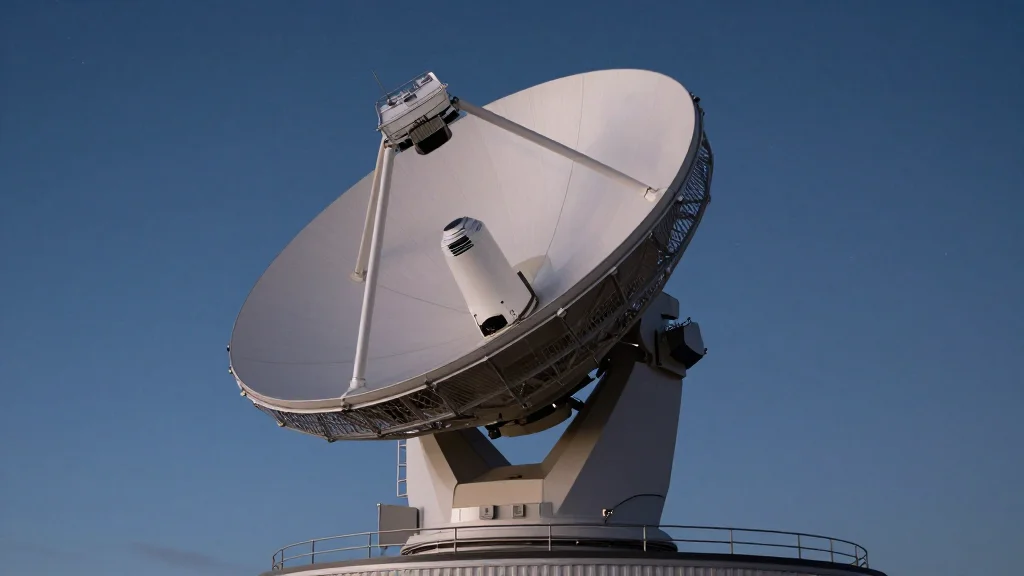
DESI Telescope Completes Its Nominal Mission, Mapping More than 47 Million Galaxies
Why It Matters
Completing the mission provides the most extensive spectroscopic galaxy catalog to date, crucial for confirming or refuting evolving dark‑energy models that could reshape cosmology. The extended data will guide theoretical work and inform future space‑based surveys.
Key Takeaways
- •DESI mapped >47 million galaxies in five‑year nominal mission
- •3‑D map covers 11 billion years of cosmic expansion
- •Early data hinted possible evolution of dark energy
- •Three more years of observations will refine constraints
Pulse Analysis
The Dark Energy Spectroscopic Instrument (DESI) represents a watershed in observational cosmology. Leveraging the Mayall 4‑meter telescope at Kitt Peak, DESI has amassed spectra for over 47 million galaxies, constructing the most detailed three‑dimensional map of the observable universe to date. This unprecedented dataset captures the large‑scale structure of matter across 11 billion years, offering a direct window into how the universe’s expansion rate has changed under the influence of dark energy.
Initial analyses of DESI’s first three years suggested a subtle deviation from the classic cosmological constant model, implying that dark energy might evolve over time. Such a shift would challenge the prevailing Lambda‑Cold Dark Matter (ΛCDM) paradigm and force theorists to reconsider the physics driving cosmic acceleration. The full five‑year data release dramatically expands statistical power, allowing scientists to test whether the early hint persists, diminishes, or intensifies, thereby sharpening constraints on the equation‑of‑state parameter w and its possible redshift dependence.
Looking ahead, DESI’s mission extends for at least another three years, promising deeper coverage and higher‑precision measurements. The continued influx of spectroscopic data will feed into next‑generation surveys like the Vera C. Rubin Observatory and the Euclid mission, creating a synergistic network of observations. For investors, policymakers, and research institutions, DESI’s findings will influence funding priorities, inform the design of future telescopes, and potentially unlock new physics that could redefine our understanding of the universe’s ultimate fate.
DESI telescope completes its nominal mission, mapping more than 47 million galaxies
Comments
Want to join the conversation?
Loading comments...