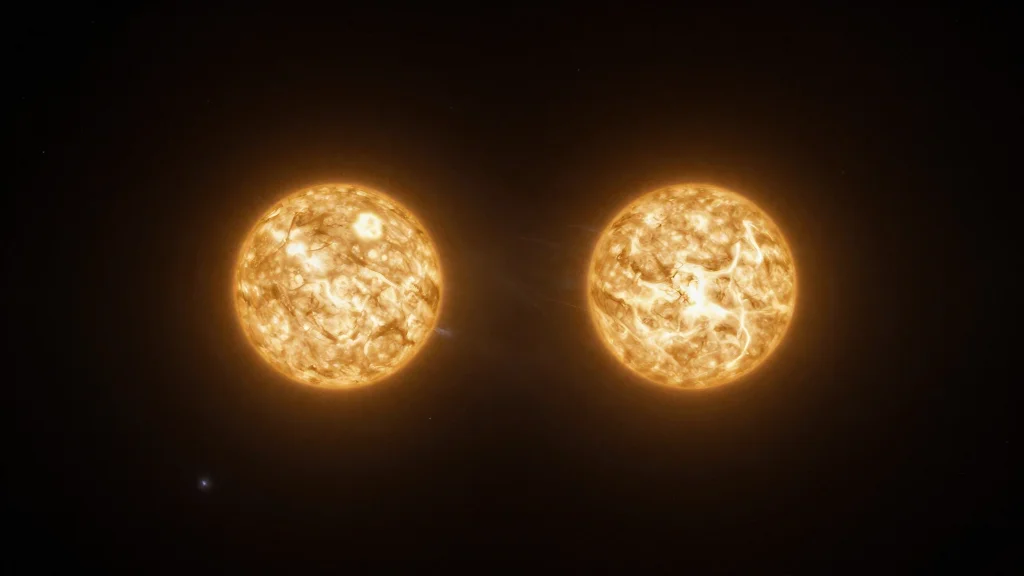
Did This Star Eat Its Planets? A New Study Offers Clues on 'Chemical Paradox' Of a Binary System
Why It Matters
Understanding planet engulfment in binary stars refines models of stellar chemistry and planetary system evolution, impacting how astronomers interpret metallicity anomalies across the galaxy.
Key Takeaways
- •HD 81809B has solar metallicity; primary star is iron‑poor by 0.57 dex.
- •Simulations require 25–75 Earth masses of metals accreted recently to match observations.
- •Lithium over‑enrichment predicts accreted mass must be under 6 Earth masses.
- •Detecting rotation or magnetic activity could confirm a planet‑engulfment event.
- •Study highlights need for precise composition data of accreted planetary material.
Pulse Analysis
Binary star systems are expected to share identical chemical fingerprints because they form from the same molecular cloud. HD 81809 defies this norm: its primary star has evolved into a subgiant with markedly low iron content, while its companion remains on the main sequence with near‑solar metallicity and elevated lithium. This discrepancy, termed a "chemical paradox," forces astronomers to look beyond standard stellar evolution and consider external influences that could alter surface abundances.
Using the MESA stellar evolution code, researchers modeled various accretion scenarios to test the planet‑engulfment hypothesis. Their results show that a recent ingestion of 25–75 Earth masses of metal‑rich material could elevate HD 81809B’s iron levels to observed values, yet such an event would also over‑produce lithium unless the accreted mass stayed below six Earth masses. This tension suggests the engulfed material must have been compositionally distinct, perhaps depleted in lithium, highlighting the need for detailed knowledge of planetary makeup in such events.
If confirmed, the findings would reshape our understanding of star‑planet interactions and chemical tagging techniques used to trace stellar origins. Future observations targeting rotational velocity and magnetic activity signatures on HD 81809B could provide the smoking gun for a recent engulfment. More broadly, the study underscores that planetary consumption may be a common, yet subtle, driver of chemical diversity in binary and single stars alike, prompting a reevaluation of metallicity as a sole indicator of stellar birth environments.
Did this star eat its planets? A new study offers clues on 'chemical paradox' of a binary system
Comments
Want to join the conversation?
Loading comments...