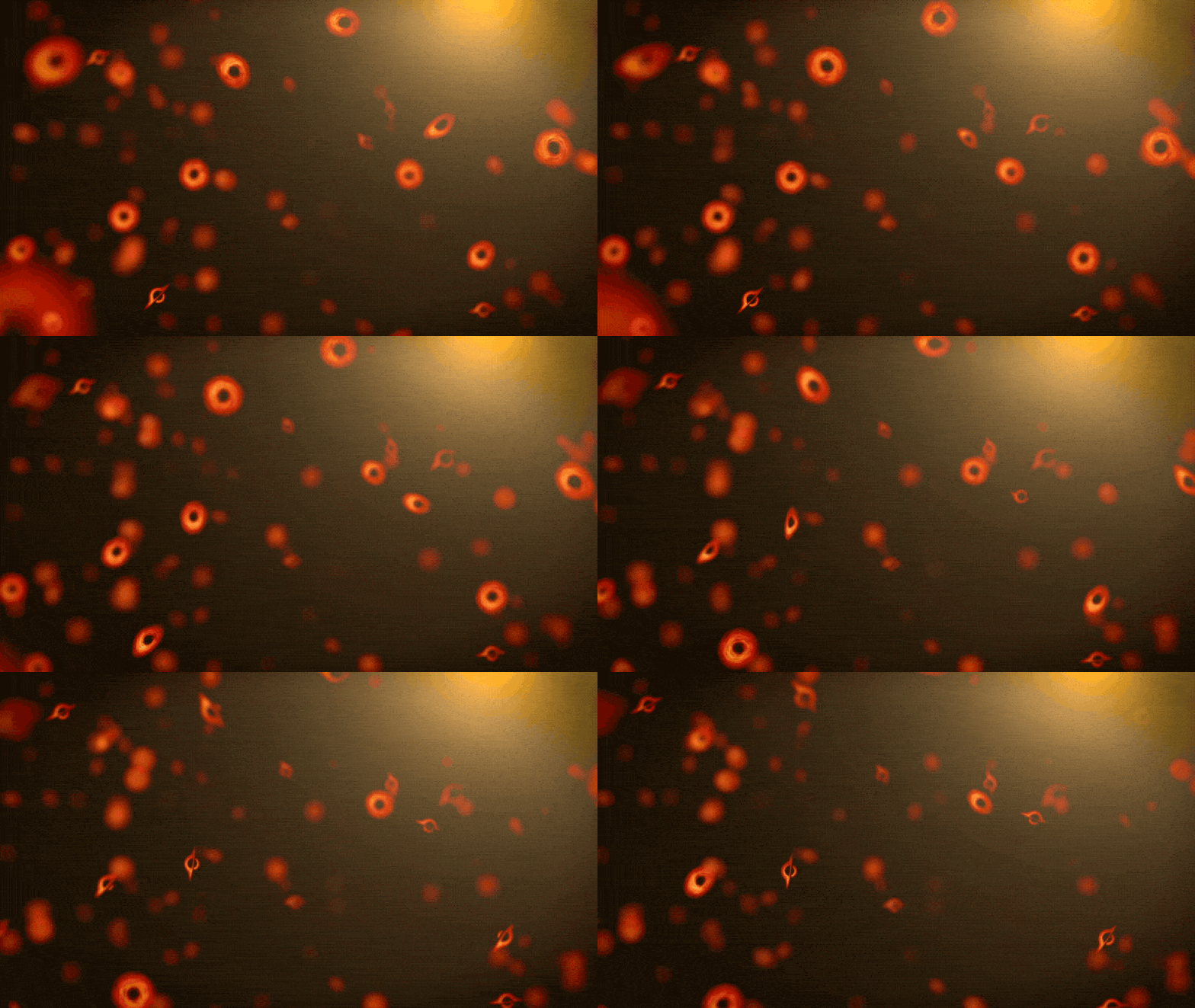
Did We Just See a Primordial Black Hole at the Milky Way’s Edge?
Why It Matters
If validated, the detection would revive primordial black holes as a viable dark‑matter candidate and offer a new pathway to understand the rapid formation of supermassive black holes in the early universe.
Key Takeaways
- •"Phoebe" candidate PBH ~3× Moon mass detected via microlensing.
- •Event lasted ~1 hour, observed in 5 nights of DECam data.
- •Alternative explanations include variable star or free‑floating planet.
- •Confirmation would support PBHs as dark‑matter component and early‑universe relics.
- •Rubin and Roman telescopes will boost PBH microlensing searches.
Pulse Analysis
Primordial black holes have long occupied a fringe corner of cosmology, first proposed in the 1960s and fleshed out by Bernard Carr and Stephen Hawking. Formed within the first fractions of a second after the Big Bang, these objects could span an enormous mass range, from sub‑atomic scales to many times the Sun’s mass. Because they interact only through gravity, a population of PBHs could account for some or all of the elusive dark matter that binds galaxies together. Over the past decade, microlensing surveys, gamma‑ray limits, and gravitational‑wave observations have whittled down the viable mass window, leaving asteroid‑mass black holes as the most plausible dark‑matter candidates.
In May, a team led by Renee Key at Swinburne University reported a candidate PBH—dubbed “Phoebe”—with a mass roughly three times that of Earth’s Moon. The object was inferred from a one‑hour brightening of a distant Large Magellanic Cloud star captured during five nights of high‑cadence imaging with the Dark Energy Camera. While the microlensing fit matches a 60,000‑light‑year‑distant, 300 km s⁻¹ black hole, the authors acknowledge weaknesses: stellar variability or a free‑floating planet could produce a similar signal, and existing OGLE data have not revealed comparable events.
If Phoebe survives rigorous follow‑up, it would provide the first empirical foothold for PBHs as a dark‑matter component and could illuminate how supermassive black holes attained enormous masses in the early universe. The episode also underscores the data‑intensive nature of microlensing searches; the five‑night run generated a terabyte of images. Next‑generation facilities such as the Vera C. Rubin Observatory and NASA’s Nancy Grace Roman Space Telescope, with their rapid, wide‑field imaging, are poised to deliver the statistical power needed to confirm or refute such rare events. Their findings will shape the next chapter of particle‑astrophysics interplay.
Did we just see a primordial black hole at the Milky Way’s edge?
Comments
Want to join the conversation?
Loading comments...