Distant Blazar OP 313 Emits Very High-Energy Gamma Rays Above 100 GeV
Why It Matters
Detecting VHE gamma rays from a quasar near redshift 1 pushes the frontier of high‑energy astrophysics and provides a new probe of the universe’s diffuse photon fields. The result validates LST‑1’s sensitivity and informs models of jet emission in the most distant active galactic nuclei.
Key Takeaways
- •OP 313 detected at >100 GeV, the most distant VHE blazar
- •Flare reached 0.3 Crab Units, 50× Fermi’s average flux
- •LST‑1’s 23‑m mirror enables detection down to 20 GeV
- •Modeling requires emission region near outer BLR edge
- •Soft spectrum shows strong extragalactic background light attenuation
Pulse Analysis
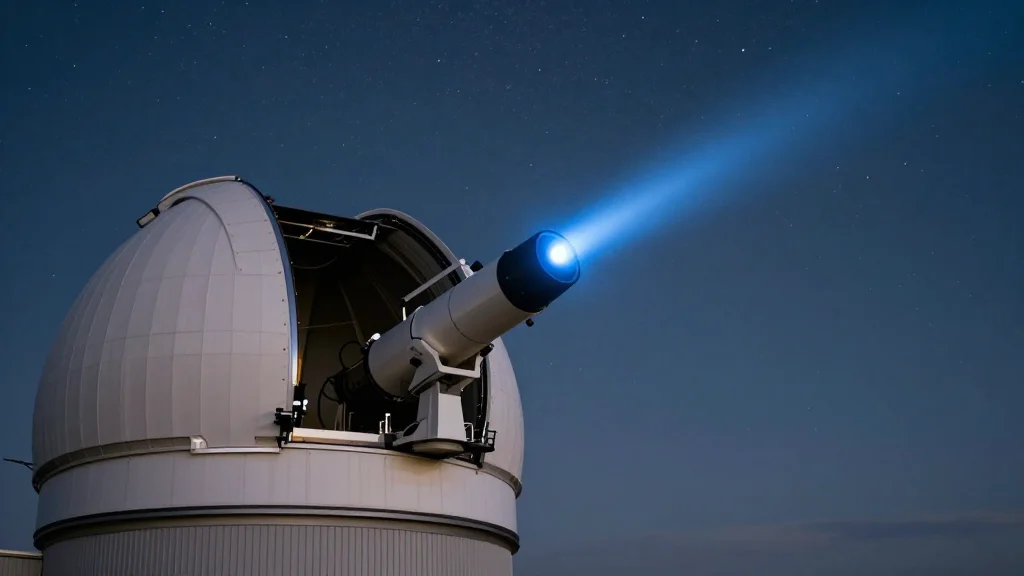
The breakthrough observation of OP 313 marks the first time a quasar at nearly redshift 1 has been seen emitting gamma rays above 100 GeV. LST‑1, the 23‑meter Large‑Sized Telescope prototype at the CTAO, delivered the sensitivity needed to capture a 0.3‑Crab flare that outshone the source’s typical high‑energy output by a factor of fifty. This achievement underscores the promise of next‑generation Cherenkov instruments for extending the gamma‑ray horizon well beyond the local universe.
Beyond the technical triumph, the detection carries weighty scientific implications. The soft VHE spectrum aligns with expectations of heavy attenuation by the extragalactic background light (EBL), offering a rare empirical constraint on photon density across cosmic distances. By fitting the broadband spectral energy distribution with a two‑zone leptonic model, researchers infer that the gamma‑ray production zone lies close to the outer edge of the broad‑line region, where external Compton scattering off dusty‑torus and BLR photons dominates. This insight refines our understanding of jet composition, particle acceleration, and radiative processes in flat‑spectrum radio quasars.
Looking ahead, OP 313’s VHE signature paves the way for systematic studies of distant blazars once the full CTA array becomes operational. A larger sample of high‑redshift VHE sources will sharpen EBL measurements, test Lorentz‑invariance violation theories, and potentially link gamma‑ray flares with neutrino or gravitational‑wave events. As CTA’s sensitivity scales, the astrophysics community anticipates a richer, more nuanced picture of the extreme universe, with LST‑1 already proving its role as a cornerstone of that future.
Distant blazar OP 313 emits very high-energy gamma rays above 100 GeV
Comments
Want to join the conversation?
Loading comments...