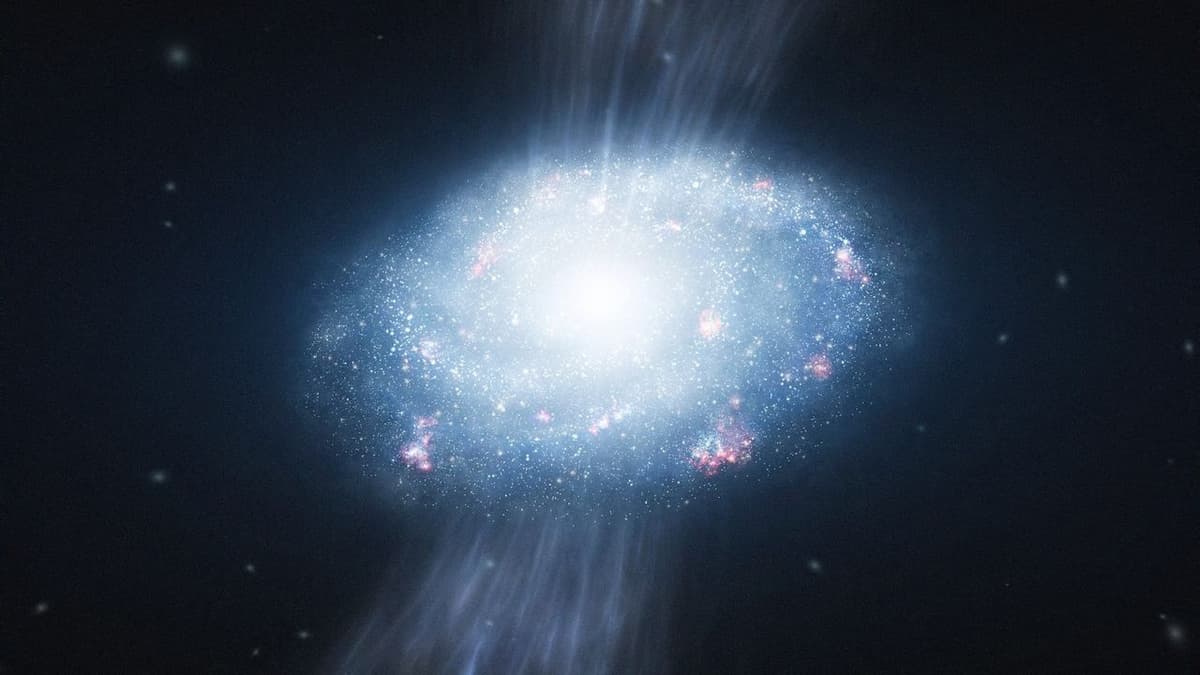
Do Galaxies Have a 'Kill Switch' That Makes Them Stop Growing?
Why It Matters
Understanding the physical trigger for galaxy quenching refines models of cosmic structure formation and informs predictions for upcoming deep‑sky surveys. It pinpoints hot‑halo physics as a key regulator of star formation in massive systems.
Key Takeaways
- •Critical halo mass ~10^12.5 solar masses triggers galaxy quenching
- •Hot gas halo becomes gravitationally stable, halting cooling inflows
- •Star‑formation efficiency drops threefold above the critical mass
- •Simulation Horizon Run 5 validates mechanism across 20,000 massive galaxies
Pulse Analysis
The transition from vigorous star formation to quiescence has long puzzled astronomers, especially because the mass at which galaxies cease to grow appears remarkably uniform across the observable universe. Traditional explanations have invoked feedback from supernovae or active galactic nuclei, yet these mechanisms struggle to account for the sharp efficiency drop observed near a halo mass of roughly three trillion suns. By anchoring the quenching phenomenon to a concrete physical state—a hot, pressure‑supported circumgalactic medium—researchers provide a unifying framework that aligns with both theoretical expectations and the statistical patterns seen in large galaxy surveys.
In the new study, the Horizon Run 5 simulation served as a virtual laboratory, modeling gravity, gas dynamics, and feedback processes across a gigaparsec‑scale volume. The team isolated the most massive central galaxies and measured their stellar‑to‑total mass ratios over billions of years. The data revealed a pronounced peak in star‑formation efficiency between 10^12.4 and 10^12.7 solar masses, followed by a steep decline once the surrounding halo attained sufficient temperature and density to remain in hydrostatic equilibrium. Crucially, the analysis showed that only about 30% of baryons were expelled, indicating that reduced inflow—not heightened outflow—drives the observed quenching.
Looking ahead, the hot‑halo hypothesis offers clear, testable predictions for next‑generation observatories such as the James Webb Space Telescope, the Vera C. Rubin Observatory, and upcoming X‑ray missions targeting the warm‑hot intergalactic medium. Detecting the thermal signatures of self‑supporting halos around massive galaxies would validate the simulation’s findings and refine the parameters used in semi‑analytic models of galaxy evolution. Ultimately, integrating hot‑halo physics into cosmological frameworks could improve forecasts of galaxy population demographics, inform dark‑matter halo occupation models, and sharpen our broader understanding of how the universe’s largest structures mature over cosmic time.
Do galaxies have a 'kill switch' that makes them stop growing?
Comments
Want to join the conversation?
Loading comments...