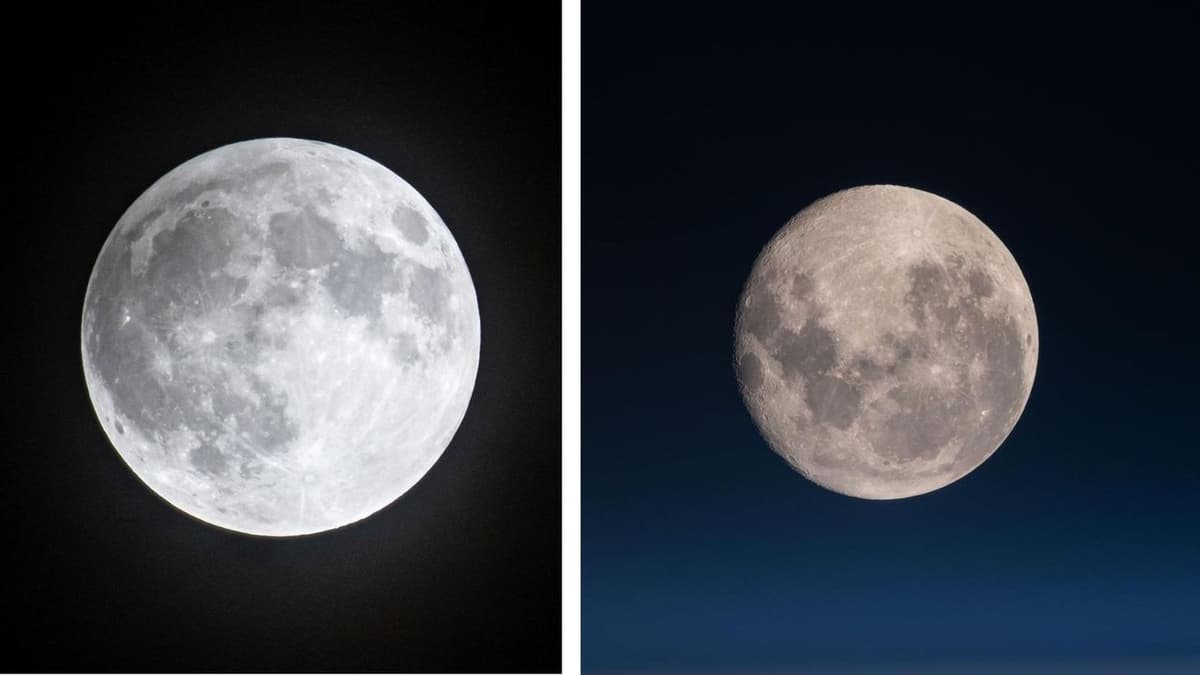
Does the Moon Look the Same From Everywhere on Earth?
Companies Mentioned

NASA
Why It Matters
Understanding these perspective effects improves public astronomy outreach and helps educators explain why cultural moon symbols differ across the globe. It also informs navigation and imaging practices that rely on consistent lunar orientation.
Key Takeaways
- •Full moon appears upside‑down from Southern Hemisphere versus Northern
- •Latitude difference rotates moon orientation up to ~97° between cities
- •Lunar phases progress opposite directions in opposite hemispheres
- •Equatorial observers see moon rotate 180° from rise to set
Pulse Analysis
Astronomy enthusiasts often assume the Moon looks identical from every point on Earth, but its orientation is a function of the observer’s latitude. At the poles, iconic features such as Tycho crater flip from bottom to top, while mid‑latitude cities can experience a nearly 100‑degree rotation due to the angle between the local horizon and the Earth‑Moon‑Sun geometry. This geographic dependence is rooted in the simple fact that observers on opposite sides of the globe view the Moon from opposite directions, a principle that underpins the design of many astronomical teaching tools.
The hemispheric flip also reshapes how lunar phases are perceived. In the Northern Hemisphere, the waxing crescent grows from right to left, whereas Southern observers see the opposite motion. Near the equator, the crescent often resembles a boat or smile because the illuminated limb aligns vertically. These visual differences have cultural ramifications: calendar icons and folklore that originated in the north can appear reversed for southern audiences, prompting a reevaluation of universal symbols in global communication.
Beyond cultural curiosity, the orientation shift has practical implications for imaging, navigation, and citizen‑science projects. Photographers and telescope users must account for a 180‑degree rotation when comparing images taken from different latitudes, and satellite‑based navigation systems that reference lunar landmarks need to incorporate latitude‑dependent corrections. By highlighting the Moon’s variable perspective, educators can turn a simple night‑sky observation into a lesson on geometry, orbital mechanics, and the interconnectedness of global viewpoints.
Does the moon look the same from everywhere on Earth?
Comments
Want to join the conversation?
Loading comments...