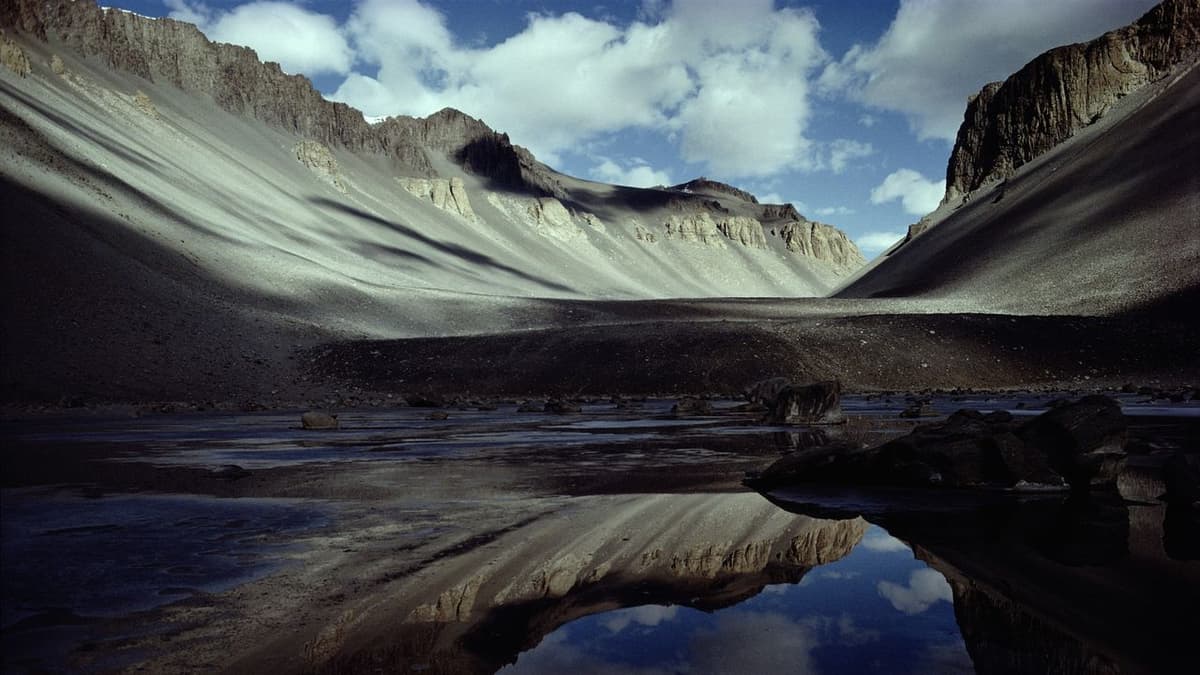
Don Juan Pond: Antarctica's Salty, Syrupy Lake that Never Freezes, Even when It's Minus 58 F
Companies Mentioned
Why It Matters
The pond’s hypersaline environment provides a rare Earth analog for Martian brines, informing astrobiology and future planetary‑exploration strategies. Understanding its water source also refines models of subsurface hydrology in extreme climates.
Key Takeaways
- •40% salinity keeps pond liquid at –58 °F.
- •Pond's calcium chloride lowers freezing point beyond Dead Sea.
- •Study debates groundwater vs atmospheric moisture as water source.
- •Analog for Martian brines informs astrobiology research.
- •Pond depth ~10 cm, area ~six football fields.
Pulse Analysis
Don Juan Pond’s extraordinary chemistry sets it apart from typical Antarctic lakes. At over 40% salinity—higher than the Dead Sea’s 34%—the calcium‑chloride‑rich brine depresses the freezing point far below the region’s record low of minus 58 °F. Its syrupy consistency and shallow depth, roughly 10 cm, create a stable liquid environment where ice would otherwise dominate. This unique combination of high salinity and extreme cold makes the pond a living demonstration of how solutes can manipulate phase transitions in water.
Scientists prize the pond as a terrestrial analog for Mars, where hypersaline, perchlorate‑laden deposits have been detected. The debate over its water source—deep groundwater versus atmospheric moisture captured by surface salts—mirrors competing hypotheses for Martian recurring slope lineae. Recent model simulations revive the groundwater theory, suggesting a hidden aquifer could sustain the pond’s chemistry, while earlier field observations highlight surface‑derived brine flows. Both scenarios offer valuable clues about how liquid water might persist under Martian conditions, guiding the design of future rover instruments and sample‑return missions.
The broader implications extend beyond planetary science. Understanding how life, if present, survives in Don Juan Pond’s extreme brine informs extremophile research and biotechnological applications such as bio‑mining and cryopreservation. Moreover, the pond serves as a natural testbed for climate‑change studies, illustrating how subtle shifts in temperature or moisture balance could alter fragile hydrological systems. As exploration of icy worlds accelerates, insights from this Antarctic lake will help shape strategies for detecting life beyond Earth.
Don Juan Pond: Antarctica's salty, syrupy lake that never freezes, even when it's minus 58 F
Comments
Want to join the conversation?
Loading comments...