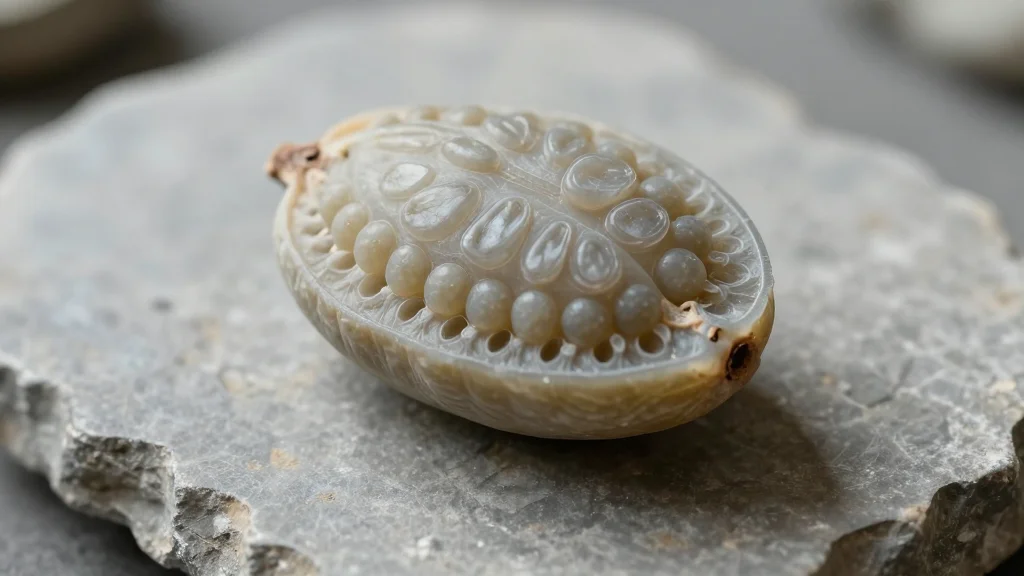
Early Permian Multi-Ovulate Fruit Rewrites Angiosperm History
Why It Matters
By moving the origin of angiosperms back 70 million years, the discovery forces a reassessment of evolutionary models and the ecological dynamics of the Permian landscape.
Key Takeaways
- •Shuozhoufructella fossils date to ≈295 million years ago
- •Fruit contains multiple ovules fixed by peripheral funiculi
- •Ovule arrangement matches angiosperm, not gymnosperm, patterns
- •Discovery pushes angiosperm origin back to Early Permian
- •Micro‑CT imaging confirmed internal fruit morphology
Pulse Analysis
The timing of angiosperm emergence has long been a contentious issue in paleobotany, with most fossil evidence clustering in the Early Cretaceous. Traditional models place flowering plants’ rise after the Permian‑Triassic extinction, attributing their diversification to later climatic stability. The new Shuozhoufructella specimen challenges that narrative, offering concrete anatomical evidence that complex fruit structures existed well before the Mesozoic, suggesting that the evolutionary groundwork for angiosperms was laid during the late Paleozoic.
Shuozhoufructella’s fruit displays a suite of features—multiple ovules, peripheral funiculi, and enclosed seed chambers—that align closely with modern angiosperm reproductive morphology. Micro‑CT scans revealed the three‑dimensional arrangement of ovules without damaging the fossil, a technique increasingly vital for resolving ambiguous structures in ancient plant remains. This methodological advance not only validates the specimen’s classification but also opens a pathway for re‑examining other Permian flora that may have been misidentified as gymnosperms.
If angiosperms indeed originated in the Early Permian, the implications ripple through evolutionary biology, paleoecology, and even climate modeling. An earlier flowering plant presence could have influenced carbon cycling, pollinator evolution, and plant‑insect interactions far earlier than previously thought. The discovery prompts a re‑evaluation of Permian ecosystems and encourages targeted searches for additional reproductive fossils, potentially rewriting a pivotal chapter of Earth’s biological history.
Early Permian multi-ovulate fruit rewrites angiosperm history
Comments
Want to join the conversation?
Loading comments...