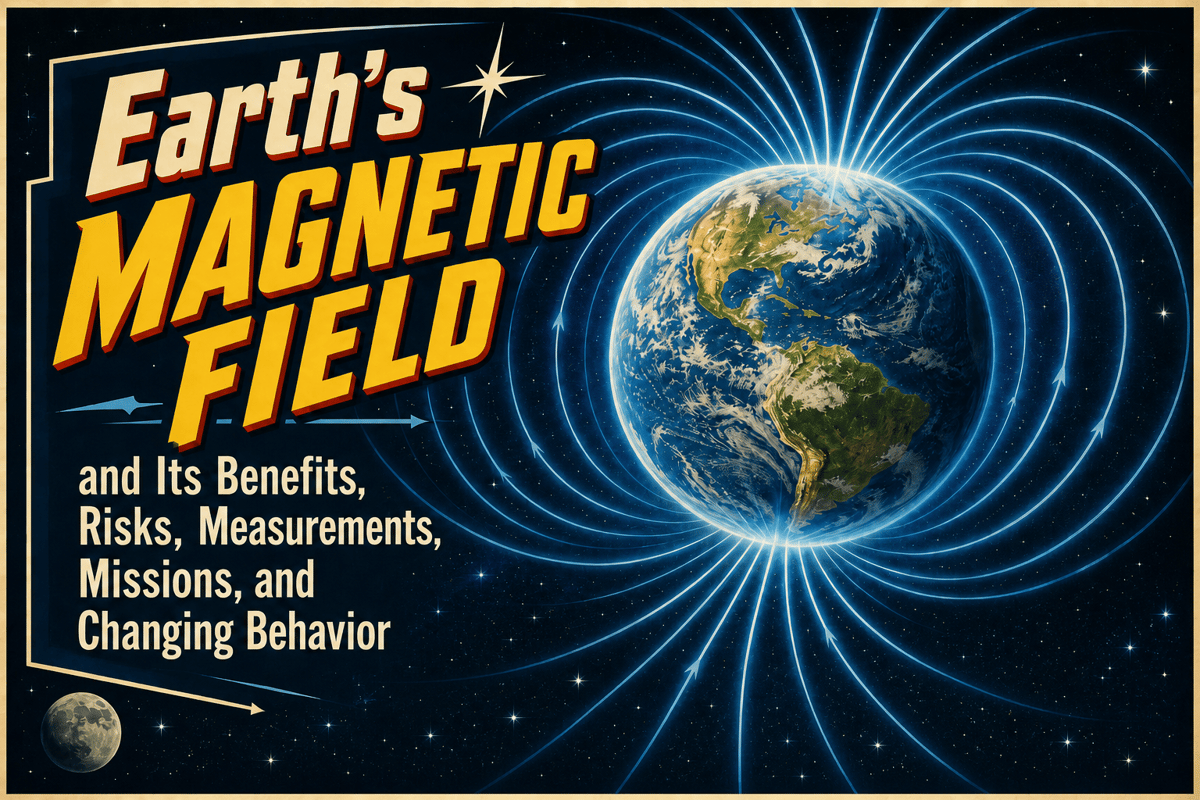
Earth’s Magnetic Field and Its Benefits, Risks, Measurements, Missions, and Changing Behavior
Companies Mentioned


Why It Matters
Accurate, up‑to‑date magnetic information is essential for navigation, satellite safety and protecting critical infrastructure from space‑weather‑induced currents.
Key Takeaways
- •Earth's field strength ranges 20 000–65 000 nT at the surface
- •97‑99% of surface field originates from the liquid outer core
- •Swarm data show South Atlantic Anomaly expanded to half Europe (2014‑2025)
- •Magnetic pole drift forces frequent updates to navigation models like WMM2025
- •Geomagnetic storms can induce currents that damage grids and satellite electronics
Pulse Analysis
Understanding Earth’s magnetic field goes beyond academic curiosity; it underpins modern navigation, resource exploration, and the safety of space‑based assets. The geodynamo in the liquid outer core generates a field that, at the surface, varies between 20 000 and 65 000 nanotesla, with more than 97 % of that signal traced to deep‑Earth currents. By combining long‑term observatory records with global satellite constellations like ESA’s Swarm, scientists can separate core, crustal and ionospheric contributions, producing high‑resolution models such as the World Magnetic Model 2025 and the High Definition Geomagnetic Model 2026. These tools are critical for everything from aircraft heading references to directional drilling, where a few degrees of magnetic declination error can translate into costly misalignments.
Recent observations highlight the field’s dynamic nature. The South Atlantic Anomaly, a region of weakened magnetic intensity, has grown to an area comparable to half of Europe over the past decade, raising radiation exposure for low‑Earth‑orbit satellites and prompting operators to adjust shielding and operational procedures. Simultaneously, the magnetic north pole continues its rapid drift toward Siberia, forcing frequent updates to navigation databases used by civilian and military platforms alike. Such secular variation, coupled with short‑term disturbances from solar storms, creates a complex environment where space‑weather forecasts and geomagnetic indices (Kp, Dst) become indispensable for grid operators, pipeline managers and aerospace engineers.
The broader implications touch policy and resilience planning. While the field has weakened roughly 9 % over the last 200 years, there is no evidence of an imminent polarity reversal, yet the ongoing changes demand continuous monitoring and model refinement. Agencies like NOAA, USGS and ESA maintain real‑time data streams, ensuring that utilities can anticipate geomagnetically induced currents and that satellite missions can schedule safe passages through high‑radiation zones. In an era where digital infrastructure is increasingly vulnerable to solar extremes, a robust understanding of Earth’s magnetosphere is a strategic asset that safeguards both economic activity and technological advancement.
Earth’s Magnetic Field and Its Benefits, Risks, Measurements, Missions, and Changing Behavior
Comments
Want to join the conversation?
Loading comments...