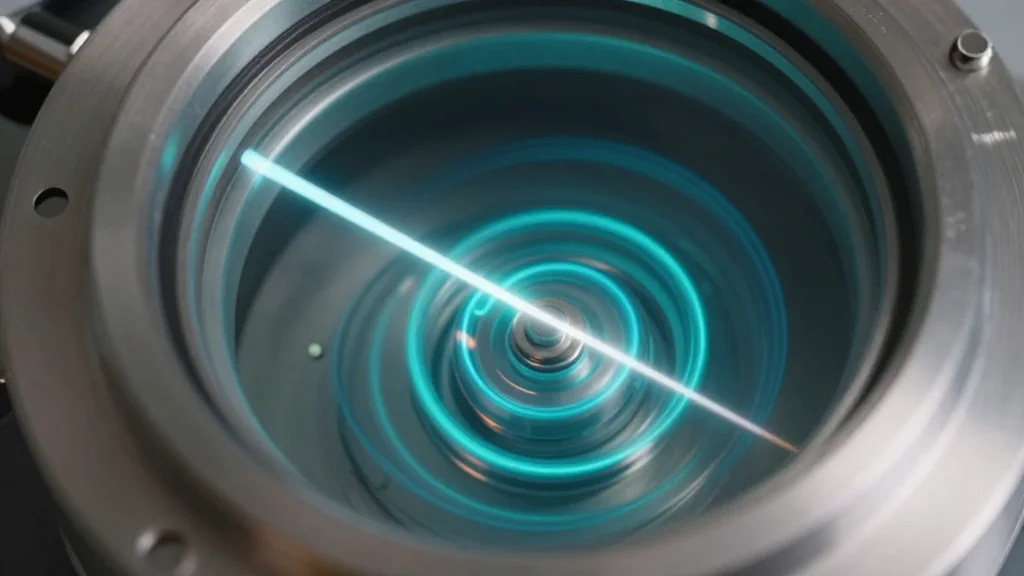
Electron Matter Waves Gain Ultrafast Torque that Flips Handedness in Femtoseconds
Why It Matters
Controlling electron angular momentum on femtosecond scales provides a powerful tool for quantum‑material research, ultra‑sensitive microscopy, and emerging quantum‑computing architectures.
Key Takeaways
- •Researchers created electron pulses with femtosecond internal torque.
- •Torque flips from left‑handed to right‑handed within femtoseconds.
- •Technique uses twisted laser wave to imprint angular momentum on electrons.
- •Pulses remain atomic‑scale focused, enabling atomic‑level rotational studies.
- •Potential applications include quantum microscopy and quantum‑computing control.
Pulse Analysis
The ability to shape electron beams has long been a frontier of ultrafast science, but most prior methods produced vortex‑like structures that were orders of magnitude larger than atomic dimensions. Conventional laser‑driven schemes could impart orbital angular momentum, yet they struggled to maintain coherence on the sub‑nanometer scale required for probing individual atoms. By leveraging a classical twisted laser field to modulate the phase of an electron wavepacket, the Konstanz team bridges that gap, delivering a beam whose internal torque can be tuned on femtosecond timescales while preserving atomic‑scale focus.
At the heart of the breakthrough is the controlled reversal of handedness—effectively a screw‑like motion that transitions from right‑handed at one end of the pulse to left‑handed at the other. This dynamic angular momentum is energy‑dependent, meaning electrons of different kinetic energies travel at slightly different speeds, causing the torque to evolve as the packet propagates. Such a self‑twisting electron wavefunction behaves like a miniature, programmable rotor, opening experimental pathways to directly interrogate spin‑orbit coupling, chiral chemical reactions, and other phenomena where rotational dynamics are pivotal.
Looking ahead, the technology promises to reshape several high‑impact domains. In quantum electron microscopy, the internal torque could serve as a contrast mechanism for detecting subtle magnetic textures or lattice symmetries without damaging samples. For quantum‑information platforms, shaped electrons may act as carriers of orbital angular momentum, adding a new degree of freedom to qubit design. As ultrafast transmission electron microscopes adopt this method, researchers can expect more precise control over matter at the intersection of time, space, and spin, accelerating discovery in materials science, chemistry, and next‑generation computing.
Electron matter waves gain ultrafast torque that flips handedness in femtoseconds
Comments
Want to join the conversation?
Loading comments...