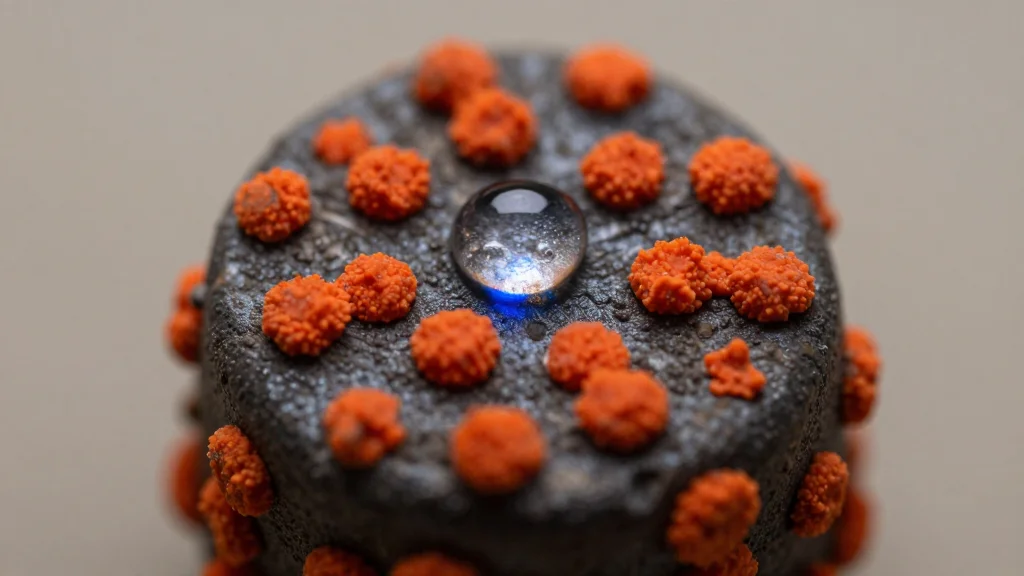
Embedded Epitaxial Growth of RuOx on Co3O4 With Strong Interaction for Efficient and Robust Acidic Water Oxidation
Why It Matters
The breakthrough lowers energy loss and extends catalyst life for acidic water electrolysis, a key hurdle for cost‑effective green hydrogen production.
Key Takeaways
- •RuOx embedded on Co3O4 forms strong Co‑O‑Ru electronic links
- •Overpotential reduced to 181 mV at 10 mA cm⁻²
- •Catalyst maintains activity for over 1,000 hours in acid
- •Dual‑oxide interface lowers *OOH formation energy barrier
- •Drop‑casting method enables low noble‑metal loading
Pulse Analysis
Acidic oxygen evolution reaction (OER) remains a bottleneck for commercial electrolyzers because most high‑performance catalysts degrade rapidly in low‑pH environments. Traditional noble‑metal oxides like IrO₂ and RuO₂ deliver low overpotentials but suffer from costly material usage and limited durability. Researchers therefore seek strategies that enhance electronic interactions and stabilize active sites while minimizing precious‑metal content, a challenge that directly impacts the economics of green hydrogen.
The RuOx‑Co3O4 system tackles this challenge by embedding RuOx particles within a Co3O₄ matrix, forging a dual‑oxide hetero‑interface rich in Co‑O‑Ru linkages. This architecture creates efficient electron‑transfer channels that replenish Ru active sites, preventing oxidation to inactive high‑valence states. The interface also reduces the energy barrier for the *OOH intermediate, shifting the OER pathway from a mixed adsorbate‑evolution/lattice‑oxygen mechanism to a predominantly adsorbate‑evolution route. Performance metrics—181 mV overpotential at 10 mA cm⁻² and >1,000 hours stability—surpass many benchmark catalysts, highlighting the potency of interface engineering over sheer material loading.
Beyond laboratory metrics, the drop‑casting synthesis is compatible with large‑scale coating processes, offering a pathway to fabricate low‑noble‑metal catalysts on commercial electrode substrates. By cutting both energy loss and material cost, this approach could accelerate the deployment of acidic electrolyzers, narrowing the gap between renewable electricity and affordable hydrogen. Future work will likely explore other transition‑metal oxides as supports, fine‑tune interface chemistry, and integrate the catalyst into full‑cell stacks, positioning RuOx‑Co3O4 as a template for next‑generation water‑splitting technologies.
Embedded Epitaxial Growth of RuOx on Co3O4 With Strong Interaction for Efficient and Robust Acidic Water Oxidation
Comments
Want to join the conversation?
Loading comments...