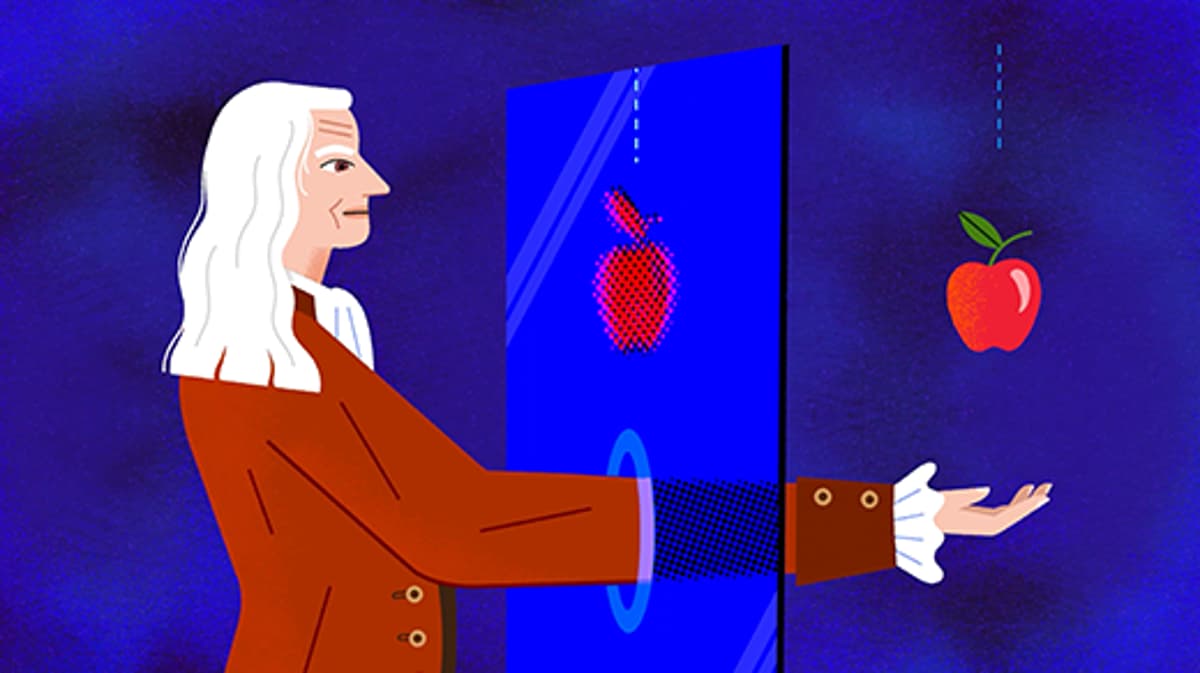
Entanglement Builds Space-Time. Now “Magic” Gives It Gravity.
Why It Matters
By tying gravity to a measurable quantum resource, the research offers a concrete pathway toward a quantum theory of gravity and opens new avenues for simulating extreme spacetime phenomena on quantum hardware.
Key Takeaways
- •Entanglement builds space; magic makes it bend
- •Non‑Clifford gates generate quantum “magic” in holographic codes
- •Magical codes let matter and geometry interact, mimicking gravity
- •Quantum computers may soon model gravitational regimes beyond Einstein
Pulse Analysis
The quest for a quantum theory of gravity has long been hampered by the difficulty of reconciling Einstein’s smooth spacetime with the discrete, probabilistic nature of quantum mechanics. Holographic dualities, pioneered by Maldacena and others, offered a breakthrough by showing that a higher‑dimensional universe can be encoded on a lower‑dimensional quantum system. In these models, entanglement between qubits acts as the connective tissue that stitches together the emergent geometry, effectively constructing space‑time from purely quantum ingredients.
Recent work by Charles Cao at Virginia Tech and collaborators adds a crucial second layer: a measure of quantumness known as “magic.” Unlike stabilizer codes that rely solely on Clifford operations, magic arises from non‑Clifford gates such as the T gate, which are computationally hard to simulate classically. By incorporating these gates into holographic error‑correcting codes, the researchers demonstrated that the encoded geometry acquires flexibility—its curvature responds to the presence of matter. In other words, magic provides the dynamical ingredient that turns a static quantum scaffold into a gravitating spacetime, fulfilling Wheeler’s second dictum that matter tells space how to curve.
The implications extend beyond theoretical elegance. If gravity can be reproduced by quantum codes rich in magic, then sufficiently advanced quantum computers could simulate black‑hole interiors, early‑universe singularities, or other regimes where general relativity fails. This bridges high‑energy physics with the rapidly evolving field of quantum information, suggesting that future breakthroughs in fault‑tolerant quantum hardware may directly enable experimental probes of quantum gravity. The research thus marks a pivotal step toward unifying two of physics’ most successful frameworks.
Entanglement Builds Space-Time. Now “Magic” Gives It Gravity.
Comments
Want to join the conversation?
Loading comments...