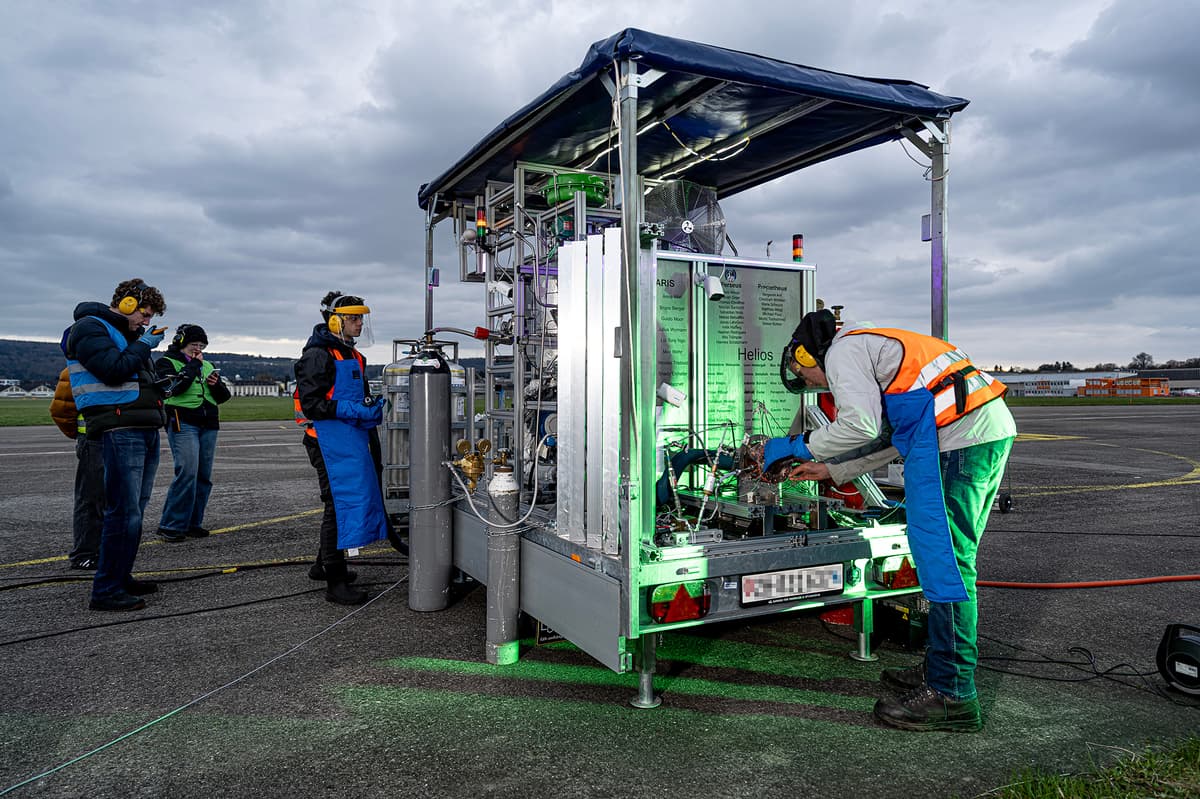
ETH Zurich Ignites Rotating Detonation Rocket Engine
Why It Matters
Stable liquid‑fuel RDRE operation proves the technology’s readiness for higher‑efficiency propulsion, potentially reshaping launch vehicle design and lowering fuel mass fractions.
Key Takeaways
- •ETH Zurich students ignited a liquid‑fuel rotating detonation engine.
- •Detonation waves rotated at up to 20,000 rev/s, achieving stable operation.
- •Metal additive manufacturing enabled the complex injector geometry required.
- •RDRE efficiency could improve thrust specific impulse by 10‑20%.
- •Only ~12 countries have tested RDREs; no other student team succeeded.
Pulse Analysis
The ETH Zurich Academic Space Initiative’s Pegasus team has moved rotating detonation rocket engines from theory to practice, delivering a live test that captured three distinct detonation waves. By using propane and liquid oxygen, the students demonstrated that a compact, liquid‑fuel RDRE can be ignited and sustained under real‑world conditions. The test’s success, achieved after two firing attempts, underscores the value of iterative design and rapid prototyping in a university setting, and it adds a new data point to the limited global RDRE experience.
Rotating detonation engines differ fundamentally from conventional rocket combustors: instead of a steady flame, they generate a supersonic detonation front that spins around a circular chamber. This process creates peak pressures and temperatures far beyond those of traditional combustion, promising a 10‑20% boost in specific impulse—a critical metric when fuel accounts for the majority of launch mass. The ETH team’s injector, produced via metal additive manufacturing, delivered the precise propane‑oxygen mix in under a millisecond, a feat that would be infeasible with conventional machining. The ability to print intricate cooling channels and injector geometries is rapidly becoming a prerequisite for RDRE development across the sector.
The broader impact reaches beyond academia. NASA, Poland’s national labs, and Japan’s space agency have all pursued RDRE research, yet only a handful of nations have flown or ground‑tested such engines. ETH Zurich’s achievement validates the technology’s maturity and showcases how university programs can accelerate innovation when paired with industry partners and metal‑AM expertise. As commercial ventures like Astrobotic and Venus Aerospace scale up RDREs for orbital and hypersonic missions, the student‑led success signals a growing pipeline of talent and a faster path toward more efficient, lower‑cost launch systems.
ETH Zurich Ignites Rotating Detonation Rocket Engine
Comments
Want to join the conversation?
Loading comments...