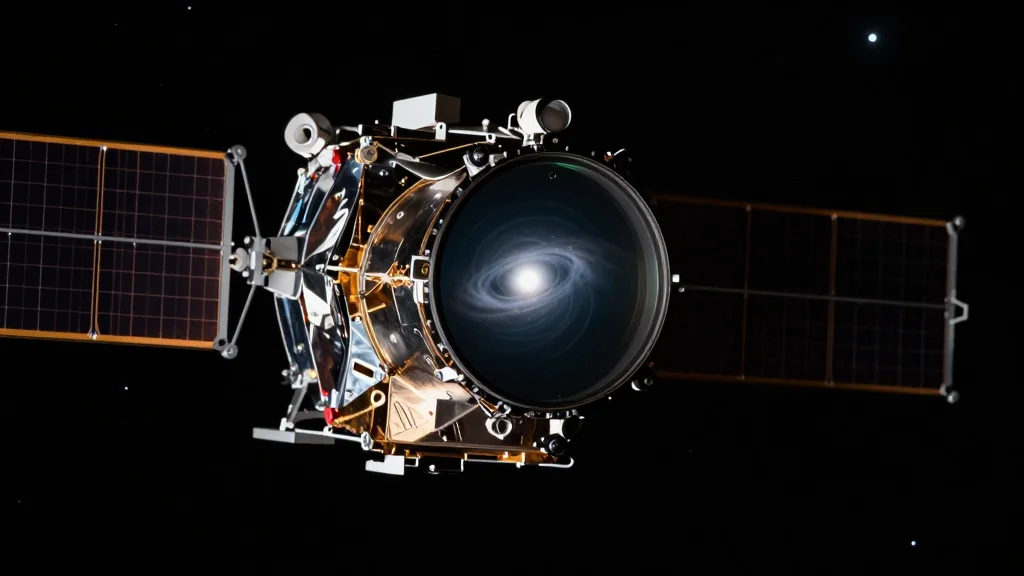
Euclid Space Warps – Help Spot Galaxies Bending Spacetime
Why It Matters
By crowdsourcing lens detection, Euclid accelerates the discovery of rare cosmic phenomena, sharpening constraints on the universe’s expansion and matter distribution. The project also deepens public engagement with cutting‑edge astrophysics, fostering a broader talent pipeline for future space research.
Key Takeaways
- •Euclid’s Space Warps taps volunteers to spot strong gravitational lenses
- •Thousands of lens candidates will improve dark‑energy measurements
- •Citizen scientists complement AI, reducing false‑positive rates
- •Public involvement boosts STEM outreach and data‑analysis capacity
Pulse Analysis
The Euclid Space Telescope, slated for launch in 2026, is designed to map the geometry of the dark universe by surveying billions of galaxies across 15,000 square degrees. While its primary instruments capture exquisite near‑infrared and optical images, the sheer volume of data exceeds the capacity of traditional analysis pipelines. To bridge this gap, the ESA has partnered with the Space Warps platform, a proven citizen‑science framework that previously enabled the discovery of dozens of strong gravitational lenses using data from the Hubble and Kilo‑Degree Survey. By presenting volunteers with image cutouts and simple classification tools, Space Warps leverages human pattern‑recognition to flag subtle lensing arcs that algorithms often miss.
Gravitational lenses are critical probes of cosmology because they magnify distant galaxies and provide direct measurements of mass distribution along the line of sight. Each newly identified lens adds a data point for testing theories of dark matter clustering and the influence of dark energy on cosmic expansion. Euclid’s unprecedented depth and sky coverage mean that even a modest success rate from volunteers could yield several thousand high‑confidence lenses, dramatically expanding the statistical power of lensing studies. Moreover, the crowdsourced catalog will feed into machine‑learning models, creating a virtuous cycle where human‑labeled examples train more accurate automated detectors for future surveys.
Beyond scientific gains, Space Warps serves as a powerful outreach conduit, inviting the public to contribute to frontier research. Participants gain hands‑on experience with real astronomical data, fostering a deeper appreciation for space science and potentially inspiring the next generation of astrophysicists. The initiative also demonstrates a scalable model for other large‑scale missions, such as the Vera C. Rubin Observatory, where citizen involvement could become an integral component of data processing pipelines. As Euclid begins delivering its first images, the collaborative effort between professional astronomers and citizen volunteers promises to accelerate discoveries and democratize access to the cosmos.
Euclid Space Warps – Help Spot Galaxies Bending Spacetime
Comments
Want to join the conversation?
Loading comments...