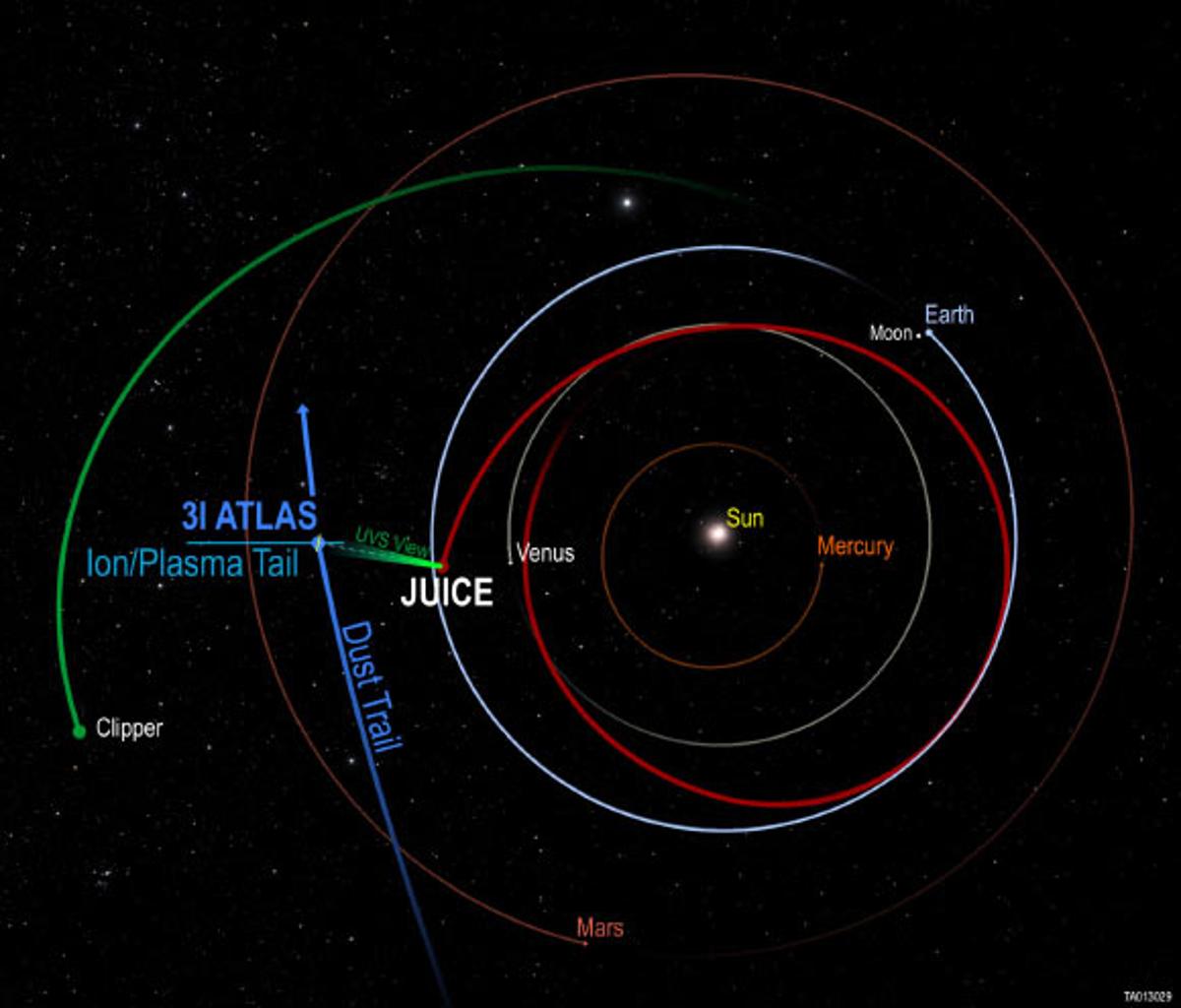
Europa Clipper and Juice Team Up to Observe Interstellar Comet 3I/ATLAS
Companies Mentioned

Why It Matters
The dual‑view dataset offers unprecedented insight into the chemistry of interstellar objects, refining models of planetary system formation beyond the Sun, and proves the scientific payoff of coordinated space‑mission observations.
Key Takeaways
- •JUICE captured bright gas emissions on comet’s day side.
- •Europa Clipper recorded dust‑laden night side of 3I/ATLAS.
- •Carbon emissions exceeded levels typical of solar‑system comets.
- •Dual‑direction UV spectroscopy revealed evolving gas ratios over days.
- •Coordination showcases potential for future joint mission science.
Pulse Analysis
Interstellar visitors like 3I/ATLAS are exceedingly rare, offering a fleeting glimpse into material that formed around another star. Since the detection of ‘Oumuamua in 2017 and comet Borisov in 2019, scientists have debated whether such objects carry signatures of alien planetary systems. The November 2025 fly‑by placed 3I/ATLAS within reach of two deep‑space assets, turning a chance encounter into a controlled experiment that expands the limited sample pool of extrasolar debris.
The collaboration leveraged the ultraviolet spectrographs aboard JUICE and Europa Clipper, each viewing the comet from a distinct geometry. JUICE’s sun‑facing perspective highlighted a bright coma rich in hydrogen, oxygen and, notably, carbon—levels that surpassed those recorded in typical Kuiper‑belt comets. Europa Clipper, positioned on the night side, captured a dense dust halo, allowing scientists to compare gas‑to‑dust ratios in real time. By tracking how these ratios shifted over several days, researchers inferred the comet’s volatile inventory and its response to solar heating, shedding light on the chemistry of its parent system.
Beyond the immediate scientific findings, the mission pair demonstrates a scalable model for future multi‑craft campaigns. As more agencies launch orbiters, landers and flyby probes, coordinated observation windows could become routine, maximizing return on investment and accelerating discovery. For planetary scientists, the 3I/ATLAS dataset provides a benchmark for interpreting remote observations of exocomets and informs theories about how planetary disks evolve in diverse stellar environments. The success of this joint effort underscores the strategic advantage of international cooperation in deep‑space exploration.
Europa Clipper and Juice Team Up to Observe Interstellar Comet 3I/ATLAS
Comments
Want to join the conversation?
Loading comments...