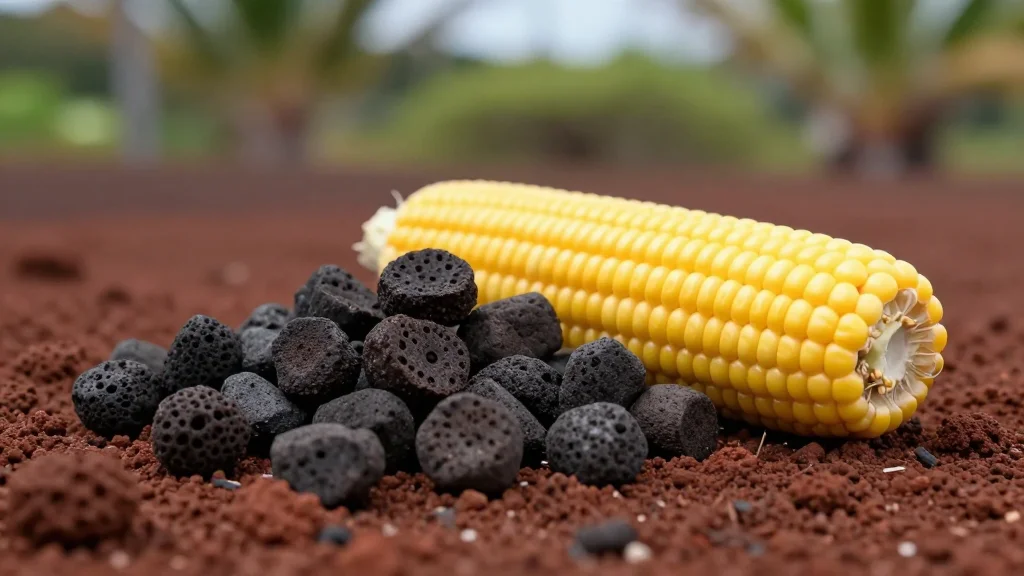
Evaluating the Application of Biochar on Sweet Corn Production, Soil Health, and Its Role in Regenerative Agriculture
Why It Matters
Biochar delivers measurable yield and soil‑health improvements, offering growers a climate‑smart tool that aligns with regenerative farming goals and could enhance food security in Hawaii and similar regions.
Key Takeaways
- •Biochar at 12.3 t/ha raised sweet corn yield 19% on Oxisol.
- •Mollisol corn yield grew 8.3% with biochar amendment.
- •Soil carbon, nitrogen, and exchangeable cations increased over 40% in Mollisol.
- •Infiltration and CO₂ respiration rates improved by ~34% after biochar.
- •Biochar boosts sugar content and pH, supporting regenerative farming in Hawaii.
Pulse Analysis
Biochar, a porous carbon‑rich material produced from pyrolyzed biomass, has moved from niche soil amendment to a cornerstone of regenerative agriculture. Its high surface area captures nutrients, retains water, and provides habitat for beneficial microbes, making it especially attractive for regions with weathered tropical soils that often suffer from low fertility and rapid drainage. As climate resilience becomes a priority, growers worldwide are testing biochar’s capacity to sequester carbon while improving crop performance, positioning it at the intersection of sustainability and profitability.
The Hawaiian study applied 12.3 t ha⁻¹ of biochar to an Oxisol and a Mollisol, two soils that differ in texture, organic matter, and nutrient dynamics. The Oxisol responded with nearly 19% higher corn yields and modest sugar gains, indicating that even highly weathered soils can benefit from carbon amendment. The Mollisol, richer in clay and organic content, exhibited dramatic enhancements: vegetative growth surged 33%, carbon and nitrogen stocks rose over 40%, and infiltration improved by 33%, suggesting better water movement and reduced runoff. These agronomic and soil‑health metrics together signal that biochar can simultaneously boost productivity and restore degraded land.
For producers, the economic case hinges on the balance between biochar purchase or production costs and the added revenue from higher yields and quality. In Hawaii, where agricultural margins are tight and import dependence is high, a 19% yield lift could translate into several hundred thousand dollars per acre over a typical corn cycle. Moreover, the carbon sequestration benefits may qualify farms for emerging climate‑offset programs, creating ancillary income streams. While scaling biochar use will require supply‑chain development and site‑specific rate optimization, the study adds robust field evidence that biochar can be a viable, climate‑positive input for tropical and subtropical agriculture.
Evaluating the application of biochar on sweet corn production, soil health, and its role in regenerative agriculture
Comments
Want to join the conversation?
Loading comments...