Evaporation-Driven Droplet Fission Study Points to Nanoscale Fabrication Potential
Why It Matters
The ability to trigger repeatable, controllable fission of sessile droplets using simple pipetting and modest electric fields opens a low‑cost pathway for nanoscale additive manufacturing and electrospray applications. It also provides a new experimental platform to study charge‑driven fluid dynamics on surfaces.
Key Takeaways
- •Ordinary pipetting creates +70 pC charged droplets that undergo Coulomb fission.
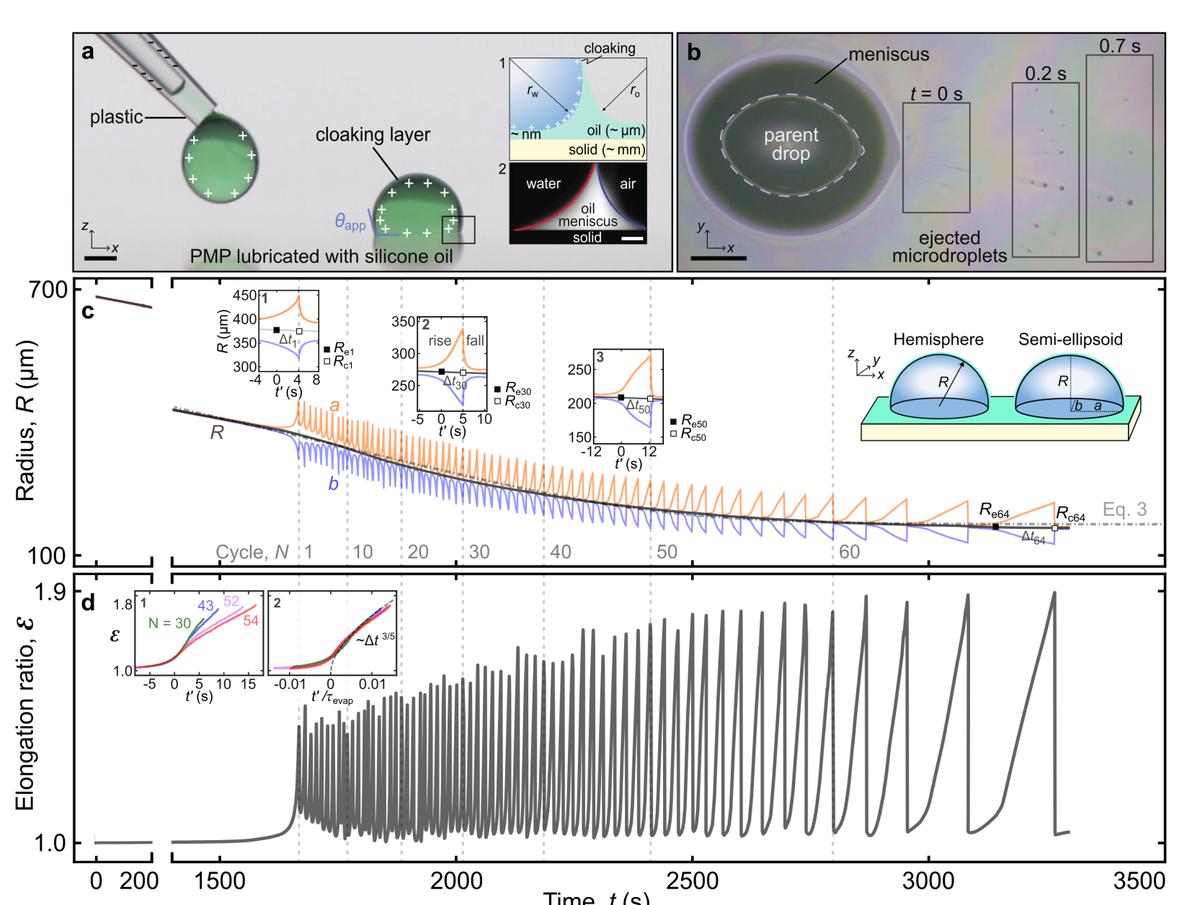
- •Lubricated silicone oil eliminates pinning, enabling >60 fission cycles in 30 min.
- •Two fissility thresholds (Xe=0.25, Xc=0.26) separate elongation from breakup.
- •Jet radius ~1 µm yields 40‑50 microdroplets; viscosity tunes distribution.
- •External field ~2000 V/m aligns jets for controlled droplet collection.
Pulse Analysis
Coulomb fission, first described by Lord Rayleigh in the 19th century, has long been observed in levitated droplets where electrostatic repulsion overcomes surface tension. Yet sessile droplets on solid substrates were thought to be immune because contact‑line pinning suppresses the necessary shape changes. The new study overturns that assumption by showing that a thin silicone‑oil film acts as a lubricant, removing pinning and forming an oil meniscus that concentrates charge. This creates a unique fission regime where droplets can repeatedly elongate, jet, and fragment while remaining anchored to the surface.
The experimental design hinges on three controllable parameters: initial charge from pipetting, oil viscosity, and an optional external electric field. A modest +70 pC charge, built up during pipetting, grows in density as the droplet evaporates, reaching two closely spaced fissility thresholds—Xe = 0.25 for elongation and Xc = 0.26 for breakup. By varying silicone‑oil viscosity from 10 mPa·s to 100 mPa·s, researchers tuned the jet morphology, producing either a fine 1 µm jet that spawns 40‑50 microdroplets or a bulkier jet that yields only a few larger droplets. An applied field of roughly 2000 V/m further aligns the jet direction, offering a straightforward handle for directed droplet collection.
These insights have immediate relevance for emerging nanomanufacturing techniques. The ability to generate uniform microdroplet streams without complex electrospray hardware could simplify additive manufacturing of functional inks, pharmaceuticals, or quantum‑dot inks. Moreover, the low voltage requirement and compatibility with standard pipetting make the process attractive for scalable, cost‑effective production lines. Future work may integrate this fission mechanism with robotic deposition platforms, enabling precise patterning at the micron scale and expanding the toolbox for next‑generation material fabrication.
Evaporation-Driven Droplet Fission Study Points to Nanoscale Fabrication Potential
Comments
Want to join the conversation?
Loading comments...