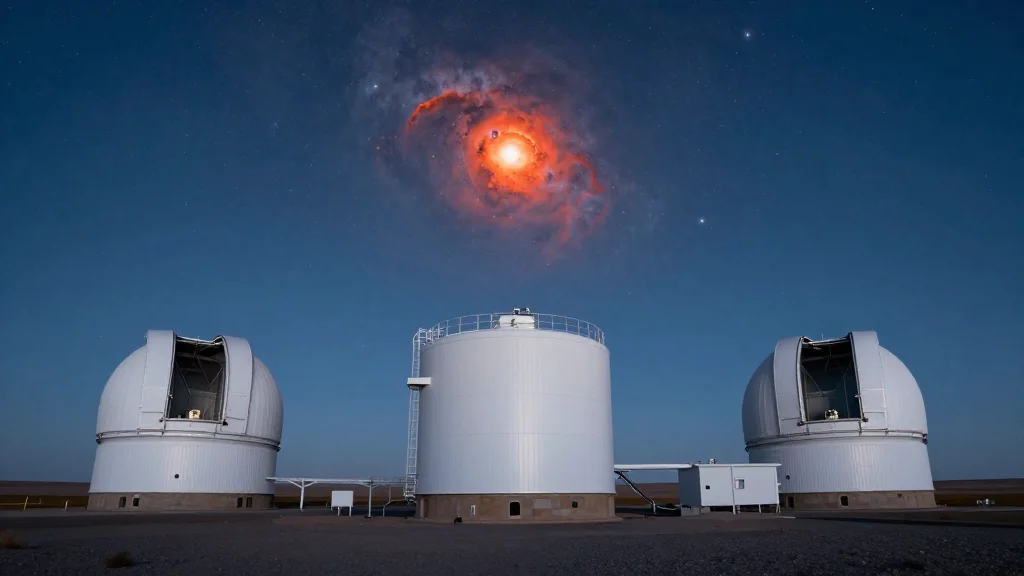
Evidence of Cosmic-Ray Acceleration From a Nearby Supernova Remnant
Why It Matters
Demonstrating proton acceleration to sub‑PeV energies validates supernova remnants as a major source of Galactic cosmic rays, reshaping models of high‑energy particle origins. The finding narrows the gap between observed cosmic‑ray spectra and their astrophysical accelerators, guiding future observational strategies.
Key Takeaways
- •LHAASO detected gamma rays from IC 443 matching pion‑decay spectrum
- •Observed gamma‑ray energies reach 0.3 PeV, indicating sub‑PeV proton acceleration
- •Findings support supernova remnants as a source of Galactic cosmic rays
- •IC 443 lies 5,000 light‑years away, exploded ~30,000 years ago
- •Hadronic scenario favored over leptonic due to spectral bump
Pulse Analysis
Cosmic rays have puzzled scientists for decades because their charged particles are scrambled by galactic magnetic fields, obscuring their birthplaces. The energy distribution of these particles shows distinct “knees” that hint at different acceleration mechanisms, yet direct evidence linking specific astrophysical objects to those features has been scarce. By focusing on neutral gamma rays—particles that travel straight from their source—researchers can bypass magnetic deflection and pinpoint where high‑energy processes occur.
The LHAASO collaboration leveraged its extensive array of water‑Cherenkov detectors and muon counters to capture gamma‑ray emissions from IC 443, a well‑studied supernova remnant interacting with a dense molecular cloud. Their spectrum displays a pronounced bump consistent with neutral‑pion decay, a hallmark of hadronic interactions where accelerated protons smash into ambient gas. The measured energies extend up to 0.3 peta‑electron‑volts (PeV) without a cutoff, demonstrating that the remnant’s shock fronts can push protons into the sub‑PeV regime, just below the cosmic‑ray knee.
This breakthrough has far‑reaching implications for high‑energy astrophysics. It confirms that at least one class of Galactic objects can generate the bulk of cosmic‑ray protons up to near‑knee energies, tightening constraints on theoretical models of particle acceleration. Future observatories, such as the Cherenkov Telescope Array, will build on LHAASO’s methodology to survey additional remnants, potentially mapping the full contribution of supernovae to the cosmic‑ray spectrum and informing the design of next‑generation space‑based detectors.
Evidence of cosmic-ray acceleration from a nearby supernova remnant
Comments
Want to join the conversation?
Loading comments...