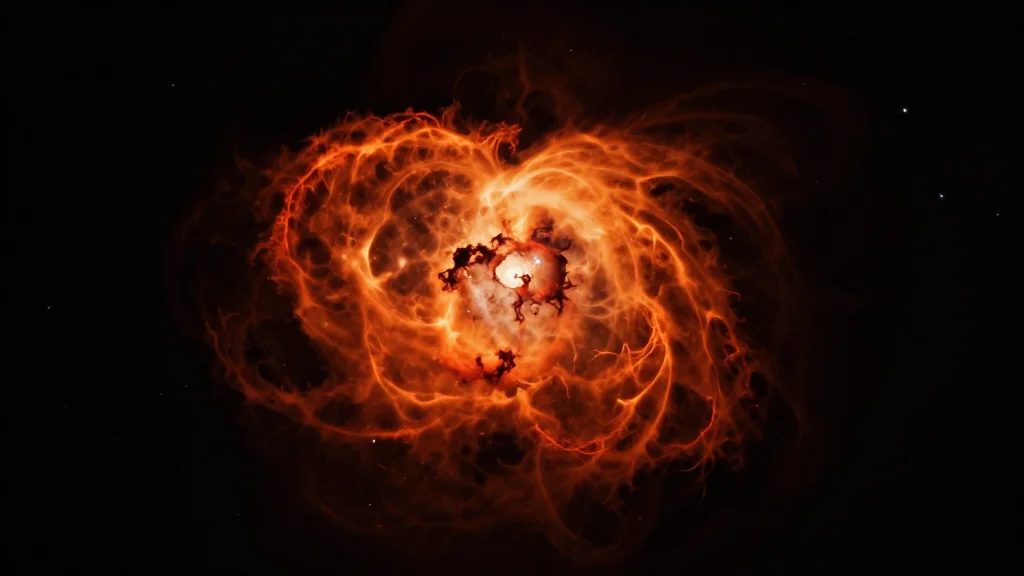
Evidence of Supernova Remnant Near the Center of the Milky Way?
Why It Matters
The remnant provides direct evidence of recent massive‑star death near the Galactic Center, refining models of gas dynamics, star formation, and feedback in extreme environments. It also improves estimates of supernova rates that shape the Milky Way’s central evolution.
Key Takeaways
- •X‑ray “blob” likely supernova remnant 26,000 ly away
- •Expands at ~2 million mph; age ≈1,700 years
- •Located on western edge of Central Molecular Zone
- •First detailed study of Sagittarius C’s high‑energy features
- •Provides nearby laboratory for supernova feedback in dense gas
Pulse Analysis
The heart of our galaxy is shrouded in dust and turbulent gas, making direct observations challenging. The Central Molecular Zone (CMZ), a massive reservoir of molecular clouds spanning roughly 1,800 light‑years, fuels intense star formation and hosts complex magnetic structures. Historically, astronomers have focused on well‑studied sub‑regions like Sgr A* and Sgr B, leaving the western fringe—Sagittarius C—relatively under‑examined. Discovering a supernova remnant in this hidden corner not only fills a geographic gap but also adds a critical data point for understanding how energetic events sculpt the CMZ’s dense environment.
The detection relied on a synergy between Chandra’s high‑resolution imaging and XMM‑Newton’s broad‑field spectroscopy. Both observatories captured a distinct blue‑colored X‑ray blob embedded within an H II region, indicating hot plasma likely produced by a recent stellar explosion. Measured expansion speeds of roughly two million miles per hour point to an age of about 1,700 years, making it one of the youngest remnants known near the Galactic Center. Its presence confirms that massive stars continue to end their lives in the CMZ, injecting kinetic energy, heavy elements, and cosmic rays that can trigger or suppress further star formation.
Beyond its immediate scientific value, the remnant serves as a natural laboratory for testing supernova feedback models in high‑density settings. Researchers can now compare multi‑wavelength data—radio filaments, infrared dust emission, and X‑ray spectra—to refine simulations of how explosions interact with surrounding molecular clouds. Future observations with the James Webb Space Telescope and upcoming X‑ray missions will likely uncover additional remnants, helping to calibrate the supernova rate in the Milky Way’s core and informing broader theories of galaxy evolution. This breakthrough underscores the importance of probing overlooked regions to reveal the dynamic processes that shape our cosmic neighborhood.
Evidence of supernova remnant near the center of the Milky Way?
Comments
Want to join the conversation?
Loading comments...