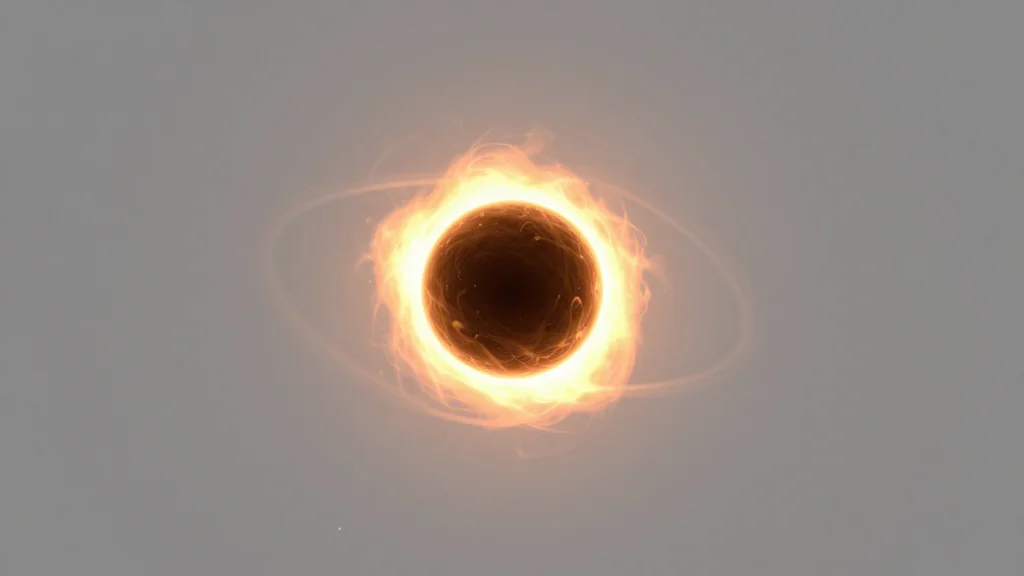
Exploding Primordial Black Holes Might Have Reshaped the Early Universe, and Created All Matter as We Know It
Why It Matters
The hypothesis links microscopic black‑hole physics to the fundamental matter‑antimatter imbalance, offering a testable pathway for cosmology and particle physics to converge.
Key Takeaways
- •Low‑mass PBHs (<5×10^14 g) evaporate explosively
- •Evaporation creates relativistic fireballs and shock waves
- •Shock waves can re‑ignite electroweak symmetry locally
- •Out‑of‑equilibrium process may drive baryogenesis
- •Study links PBH explosions to matter‑antimatter asymmetry
Pulse Analysis
The concept that primordial black holes could have acted as cosmic detonators revives interest in Hawking radiation beyond theoretical curiosity. By modeling the final moments of sub‑stellar PBHs, the authors show that the energy release is not a gentle diffusion but a focused blast that drives a relativistic shock through the quark‑gluon plasma. This perspective bridges high‑energy astrophysics with early‑universe plasma dynamics, suggesting that the microphysics of black‑hole evaporation can imprint macroscopic structures on the nascent cosmos.
A critical implication of these shock‑driven fireballs is their ability to temporarily raise local temperatures above the electroweak symmetry‑breaking threshold (~162 GeV). In standard cosmology, the universe cools monotonically, freezing out the electroweak force and locking in a symmetric matter‑antimatter state. The PBH‑induced reheating creates pockets where symmetry is restored, generating the necessary departure from thermal equilibrium. Such pockets provide a natural arena for CP‑violating processes to favor baryons over antibaryons, addressing the long‑standing baryogenesis problem without invoking exotic new particles.
If observational signatures—such as specific gravitational‑wave backgrounds or relic plasma anisotropies—can be tied to these early shocks, the theory could become falsifiable. Moreover, the framework offers a unifying narrative: microscopic black‑hole physics, plasma hydrodynamics, and particle‑physics symmetry breaking all converge to explain why the observable universe is matter‑dominated. This interdisciplinary angle may inspire new collaborations across cosmology, high‑energy physics, and astrophysical fluid dynamics, accelerating progress toward a comprehensive model of the universe’s first seconds.
Exploding primordial black holes might have reshaped the early universe, and created all matter as we know it
Comments
Want to join the conversation?
Loading comments...