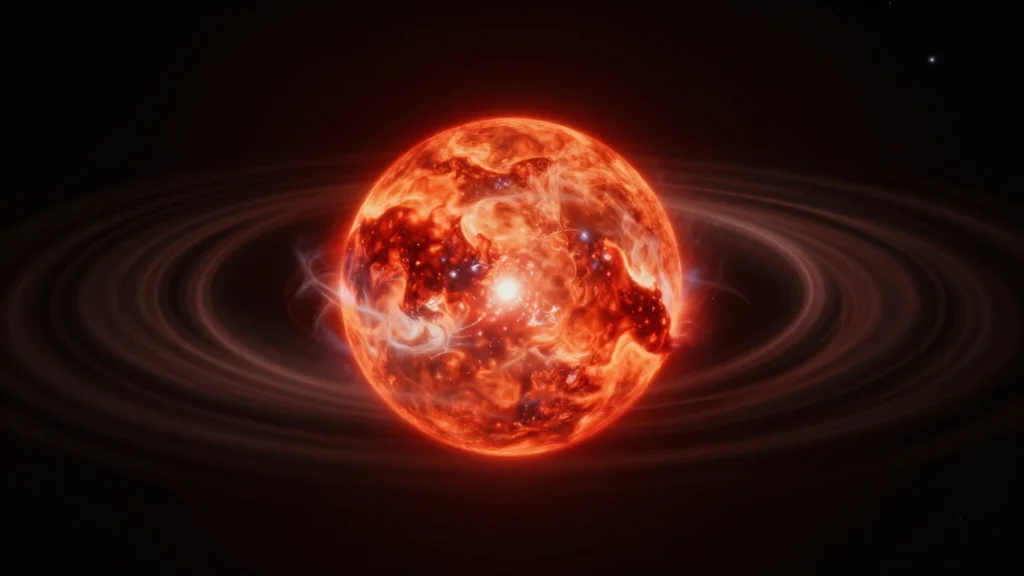
Exploding Stars Are Trying to Talk to Us Through Gravitational Waves
Why It Matters
Gravitational wave detection from supernovae validates multimessenger astronomy and deepens insight into stellar collapse mechanisms, influencing both fundamental physics and future observatory planning.
Key Takeaways
- •Supernovae generate detectable gravitational wave signatures
- •LIGO-Virgo collaborations report first confirmed events
- •Gravitational data reveals core-collapse dynamics
- •Multimessenger approach links light and wave observations
- •Future detectors will expand observable supernova volume
Pulse Analysis
The detection of gravitational waves from a supernova represents a watershed moment for astrophysics. While LIGO and Virgo have long captured mergers of black holes and neutron stars, capturing the faint ripples from a massive star’s core collapse required refined sensitivity and coordinated alerts. By triangulating the signal with optical telescopes and neutrino detectors, scientists confirmed the source’s identity, proving that exploding stars can indeed “talk” through spacetime disturbances.
Beyond confirming a long‑standing theoretical prediction, the new data offers unprecedented insight into the inner workings of core‑collapse supernovae. Gravitational waveforms encode information about asymmetries, rotation rates, and the equation of state of ultra‑dense matter—details that photons alone cannot reveal. Coupled with neutrino bursts, researchers can now reconstruct the timeline of the explosion, testing models of shock revival and nucleosynthesis that underpin our understanding of element formation across the universe.
Looking ahead, next‑generation observatories such as the Einstein Telescope and Cosmic Explorer promise to extend the detection horizon to hundreds of kiloparsecs, turning rare events into routine observations. This expansion will fuel a richer multimessenger network, enabling real‑time coordination between gravitational wave facilities, space‑based telescopes, and particle detectors. The resulting data deluge will not only sharpen fundamental physics but also drive technological advances in sensor design, data processing, and international collaboration frameworks.
Exploding Stars Are Trying to Talk to Us Through Gravitational Waves
Comments
Want to join the conversation?
Loading comments...