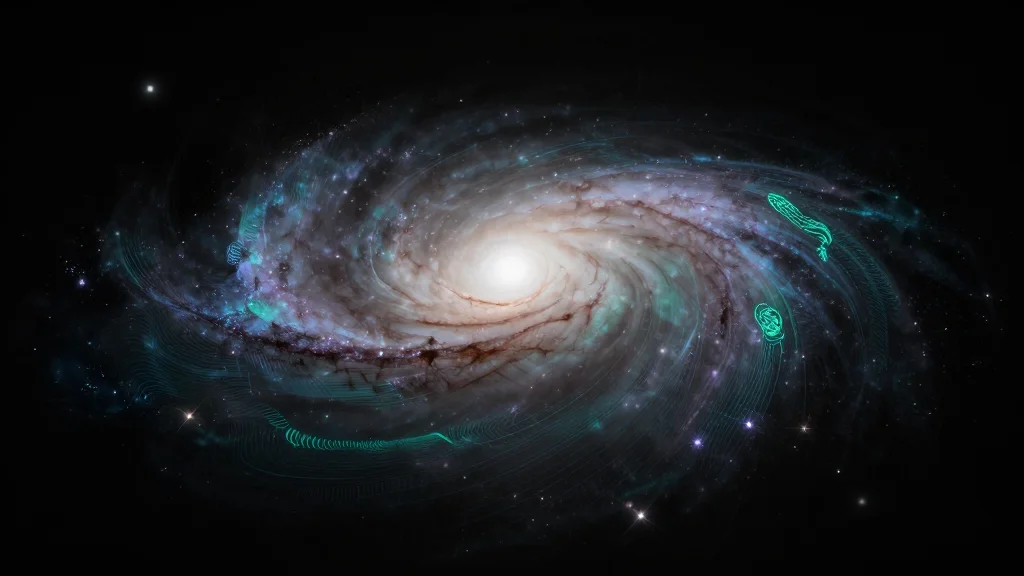
Extragalactic Archaeology Tells the 'Life Story' Of a Whole Galaxy
Why It Matters
By turning a single snapshot into a detailed biography, the method gives astrophysicists a powerful new tool to decode galaxy formation and merger histories, accelerating our understanding of cosmic evolution. It also demonstrates how AI and large‑scale simulations can extract deep insights from existing telescope data.
Key Takeaways
- •AI matches oxygen fingerprints to 20,000 simulated galaxy histories.
- •NGC 1365’s core formed 13.7 billion years ago, per chemical map.
- •Outer regions grew via dwarf galaxy mergers over 12 billion years.
- •Method could create a field guide for typical galaxy evolution.
Pulse Analysis
Extragalactic archaeology leverages high‑resolution spectroscopic surveys and machine‑learning algorithms to translate elemental distributions into chronological narratives. By focusing on oxygen—a reliable tracer of stellar nucleosynthesis—researchers can pinpoint epochs of intense star formation, supernova enrichment, and gas inflow. The technique sidesteps the limitations of redshift dating, which only provides a coarse age proxy, and instead offers a granular view of internal processes that shape a galaxy’s structure over billions of years.
The proof‑of‑concept study on NGC 1365 illustrates the method’s potential. Researchers generated 20,000 simulated galaxies, each with varied merger histories, star‑formation rates, and black‑hole activity. AI then identified the simulation whose chemical map best aligned with the observed oxygen gradient, revealing a central core forged near the universe’s birth and peripheral growth driven by successive dwarf‑galaxy accretions. This level of detail, extracted from a single data cube, marks a paradigm shift in how astronomers reconstruct galactic timelines.
Looking ahead, expanding the chemical toolkit beyond oxygen—incorporating nitrogen, sulfur, and iron—will sharpen the resolution of these cosmic biographies. Coupled with next‑generation observatories like the James Webb Space Telescope and upcoming 30‑meter class ground‑based telescopes, the approach could produce a comprehensive “field guide” for galaxy evolution. Such a guide would not only map the life stories of distant systems but also provide a comparative baseline for interpreting the Milky Way’s own formation history, deepening our grasp of the universe’s grand narrative.
Extragalactic Archaeology tells the 'life story' of a whole galaxy
Comments
Want to join the conversation?
Loading comments...