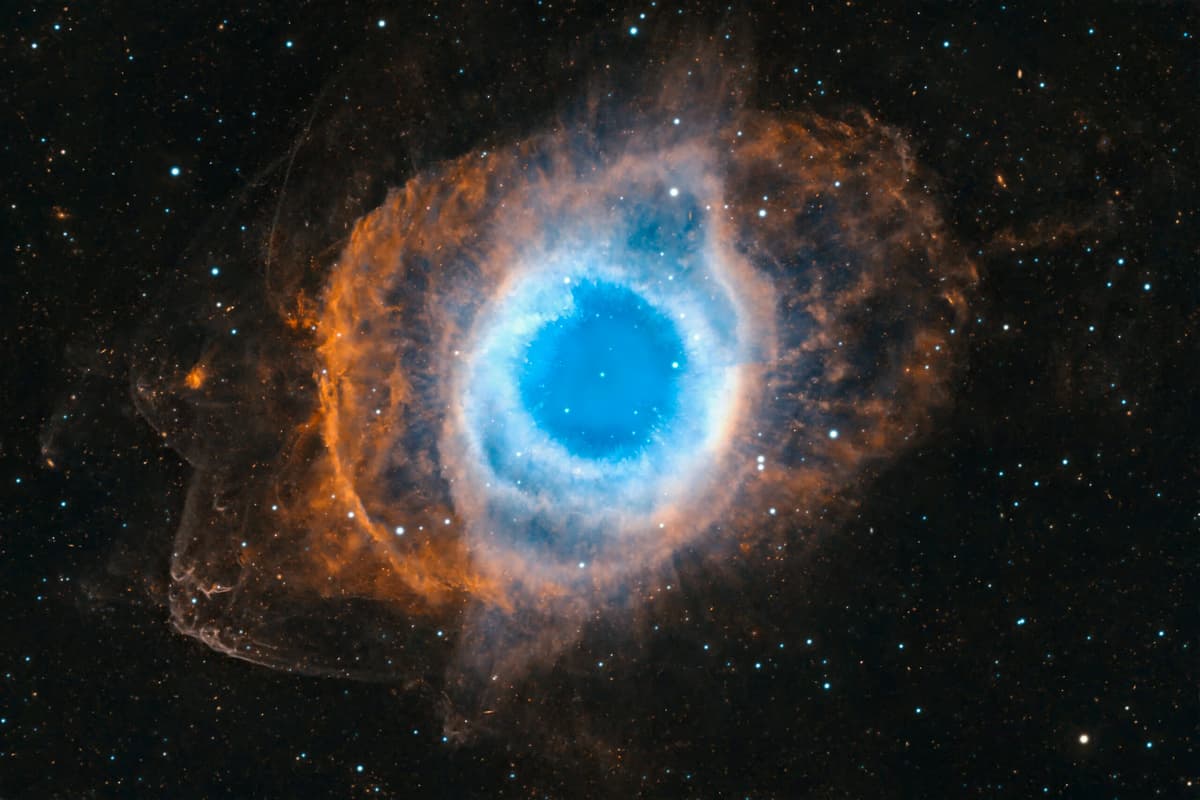
Why It Matters
The Helix Nebula offers a nearby laboratory for studying stellar death, enriching our understanding of planetary nebula formation and inspiring public interest in space science.
Key Takeaways
- •Helix Nebula located ~650 light‑years away in Aquarius
- •Also known as Eye of God or Eye of Sauron
- •Formed from Sun‑like star shedding outer layers
- •Central white dwarf emits intense ultraviolet radiation
- •Visible in amateur telescopes, popular astrophotography subject
Pulse Analysis
The Helix Nebula, situated in Aquarius, is one of the closest and most detailed planetary nebulae observable from Earth. Its iconic eye‑shaped silhouette arises from concentric shells of ionized gas, sculpted into comet‑like knots by the intense ultraviolet output of the central white dwarf. Modern telescopes and image‑processing techniques reveal a complex tapestry of glowing filaments, making the nebula a benchmark for calibrating instruments and testing models of gas dynamics in late‑stage stellar evolution.
From a scientific perspective, the Helix provides a rare glimpse into the transitional phase when a Sun‑type star exhausts its nuclear fuel and sheds its envelope. Researchers analyze the nebula’s chemical composition, density gradients, and expansion velocity to refine theories about mass loss, dust formation, and the enrichment of the interstellar medium. Its proximity allows high‑resolution spectroscopy, helping astronomers trace the lifecycle of elements that will eventually seed new generations of stars and planets, thereby linking stellar death to cosmic recycling.
Beyond academia, the Helix’s striking visual appeal fuels public fascination with astronomy. Its frequent appearance in outreach programs, planetarium shows, and social media showcases the power of astrophotography to bridge complex science and popular culture. By featuring the nebula in its Picture of the Day, Astronomy Magazine amplifies educational outreach, encouraging amateur observers to seek out the nebula with modest equipment and fostering a broader appreciation for the universe’s dynamic beauty.
Eye in the sky
0
Comments
Want to join the conversation?
Loading comments...