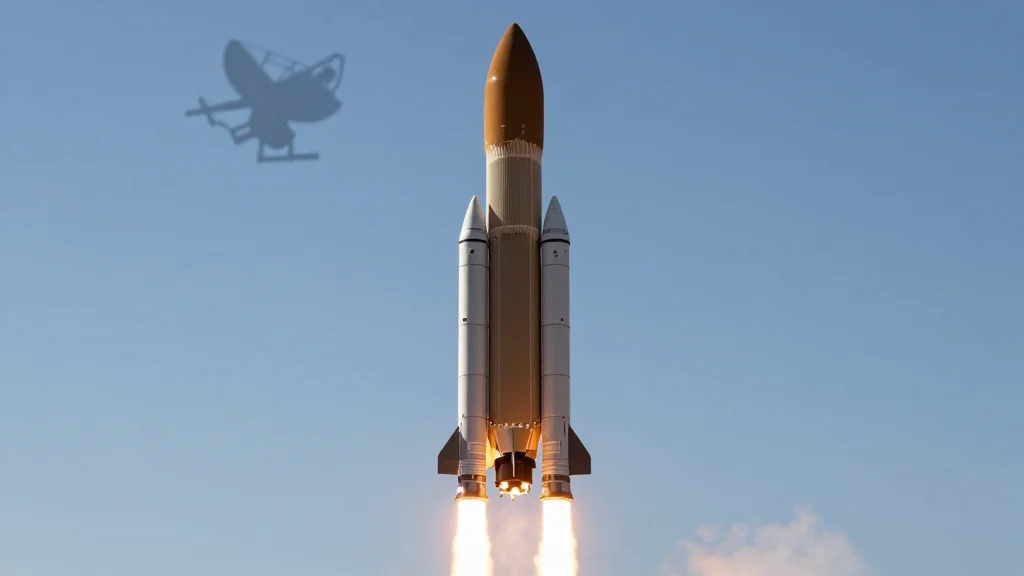
Falcon Heavy Returns to Flight with ViaSat-3 Mission
Why It Matters
Completing the ViaSat‑3 constellation expands worldwide broadband reach while reaffirming SpaceX’s leadership in heavy‑lift, reusable launch services, a critical advantage in the growing commercial satellite market.
Key Takeaways
- •Falcon Heavy's first launch in 18 months lifts ViaSat-3 III.
- •ViaSat-3 III completes a decade‑long terabit satellite constellation.
- •Both side boosters successfully landed for reuse at Cape Canaveral.
- •Satellite targets geostationary orbit to expand global broadband coverage.
- •Launch underscores SpaceX's dominance in heavy‑lift commercial market.
Pulse Analysis
Falcon Heavy’s return after an 18‑month pause underscores SpaceX’s commitment to maintaining a reliable heavy‑lift capability for commercial customers. The rocket’s ability to recover and reuse its side boosters reduces launch costs and shortens turnaround times, reinforcing the company’s value proposition in a market where price and schedule are paramount. This successful flight also serves as a proof point for SpaceX’s operational resilience, reassuring satellite operators that the heavy‑lift platform remains a dependable choice for high‑value payloads.
ViaSat’s final satellite in the three‑satellite ViaSat‑3 series brings terabit‑class capacity to a constellation designed to deliver high‑speed broadband to underserved regions worldwide. Each satellite carries a payload capable of transmitting up to 1 Tbps, a quantum leap over legacy systems, and positions ViaSat to compete directly with rivals like OneWeb and Starlink in the emerging global connectivity arena. The completion of the constellation, a project spanning more than a decade, reflects the maturation of high‑throughput satellite technology and the growing appetite for satellite‑based internet services among enterprises, governments, and remote communities.
The launch has broader implications for the commercial space ecosystem. SpaceX’s demonstrated ability to launch large, high‑value payloads on a reusable heavy‑lift vehicle pressures legacy providers such as United Launch Alliance and Arianespace to accelerate their own reusability programs. Moreover, the successful deployment of a high‑capacity broadband satellite signals sustained demand for satellite infrastructure, encouraging further investment in next‑generation constellations and ground‑segment technologies. As bandwidth needs continue to surge, the partnership between SpaceX and ViaSat exemplifies how launch efficiency and satellite performance together drive the future of global connectivity.
Falcon Heavy Returns to Flight with ViaSat-3 Mission
Comments
Want to join the conversation?
Loading comments...