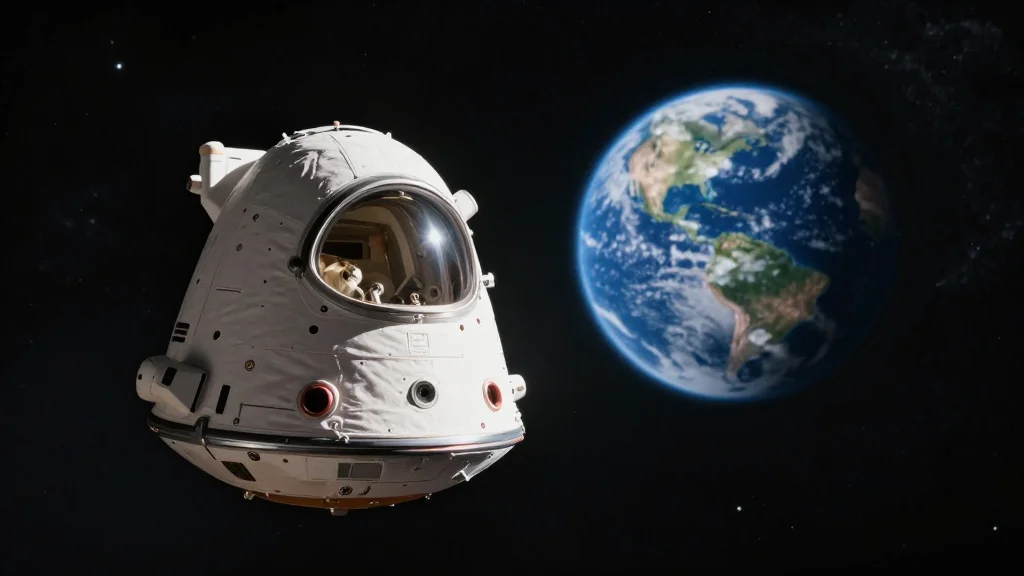
Far Away Objects
Why It Matters
The record validates the Artemis program’s ability to send humans farther into space, a prerequisite for future lunar‑gateway and Mars missions. It also provides a measurable benchmark for commercial and international partners developing deep‑space crew capabilities.
Key Takeaways
- •Artemis II reached 406,771 km, farthest crewed spacecraft distance
- •Voyager 1 sits ~25.4 billion km from Earth, still active
- •Moon distance (~394,300 km) is comparable to Artemis II peak
- •Mars at opposition lies ~401 million km, far beyond Artemis II
Pulse Analysis
Artemis II’s 406,771 km milestone marks the first time a crewed vehicle has ventured beyond the Moon’s orbit, underscoring NASA’s renewed focus on deep‑space exploration. The Artemis program, slated to establish a sustainable lunar presence, uses this record as a proof point for the Orion capsule’s life‑support, navigation, and radiation‑shielding systems. By pushing the envelope of crewed distance, the mission builds confidence among commercial partners eager to offer services for lunar‑gateway logistics and eventual Mars transit.
While Artemis II set a human‑flight distance record, it still pales in comparison to unmanned pioneers. Voyager 1, launched in 1977, now drifts over 25 billion km from Earth, traversing interstellar space, and Voyager 2 follows at roughly 21 billion km. The Moon remains a nearby benchmark at about 394,300 km, and Mars, at its farthest, sits near 401 million km. These comparisons highlight the technological gap between crewed and robotic missions, emphasizing the challenges of life‑support, communication latency, and radiation protection that must be solved before humans can match the probes’ reach.
The Artemis distance achievement has ripple effects across the aerospace market. It signals to investors that deep‑space crewed missions are transitioning from concept to operational reality, spurring interest in propulsion innovations, in‑space manufacturing, and habitat development. Commercial entities such as SpaceX, Blue Origin, and emerging European firms can leverage the data to design compatible crew modules and support services. Ultimately, the record sets a new performance baseline that will shape policy, funding, and international collaboration as the industry eyes a sustainable presence beyond Earth’s immediate neighborhood.
Far Away Objects
Comments
Want to join the conversation?
Loading comments...