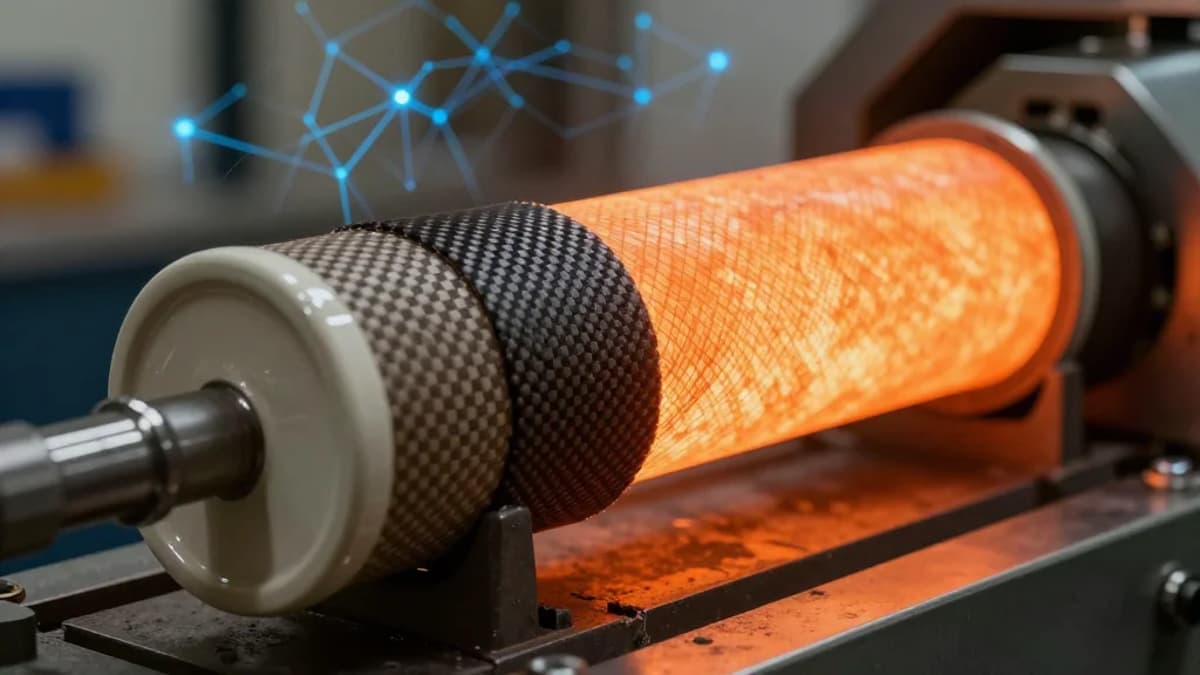
Fatigue Life Prediction of Ceramic Matrix Composite Materials Based on Physical Constraint Multi-Scale Attention Network
•March 12, 2026
0
Why It Matters
Accurate fatigue predictions extend component lifespans and reduce costly over‑design in aerospace and power‑generation sectors. The approach bridges data‑driven AI with material physics, setting a new benchmark for composite reliability assessments.
Key Takeaways
- •PC‑MSANet outperforms LSTM, MLP, SVR in fatigue prediction
- •RMSE reduced from 905.6 to 630.0 with physical constraints
- •R² improved to 0.975, achieving 99% CSR satisfaction
- •Features include stress, time statistics, frequency‑domain energy
- •Method enables high‑precision service‑life evaluation for composites
Pulse Analysis
Ceramic matrix composites (CMCs) are prized for their high‑temperature strength and corrosion resistance, yet their fatigue behavior remains notoriously complex. Traditional empirical models struggle to capture the interplay of micro‑scale damage mechanisms and macro‑scale loading conditions, leading to conservative life estimates that inflate material costs. As aerospace engines and gas turbines push performance envelopes, manufacturers demand predictive tools that can reliably forecast crack initiation and propagation across varied stress spectra.
The Physically Constrained Multi‑Scale Attention Network (PC‑MSANet) addresses this gap by fusing deep learning with domain‑specific physics. By extracting multi‑scale features—macroscopic stress, time‑domain statistics, and frequency‑domain energy—the network learns hierarchical representations of fatigue damage. Embedding physical constraints into the loss function forces predictions to honor known material behavior, dramatically lowering RMSE from 905.6 to 630.0 and boosting R² to 0.975. Compared with conventional LSTM, MLP, and SVR models, PC‑MSANet delivers superior accuracy and stability, achieving a 99 % CSR satisfaction rate that signals near‑perfect compliance with service‑life criteria.
The implications for industry are profound. Engineers can now integrate PC‑MSANet into design‑for‑durability workflows, reducing safety margins without compromising reliability. This translates to lighter, more efficient components and shorter certification cycles for next‑generation turbines and hypersonic vehicles. Moreover, the methodology sets a precedent for coupling physics‑based constraints with attention mechanisms across other high‑performance materials, opening avenues for predictive maintenance and digital twin implementations. As the aerospace and energy sectors prioritize sustainability and cost‑effectiveness, such AI‑enhanced material models will become indispensable assets.
Fatigue life prediction of ceramic matrix composite materials based on physical constraint multi-scale attention network
0
Comments
Want to join the conversation?
Loading comments...