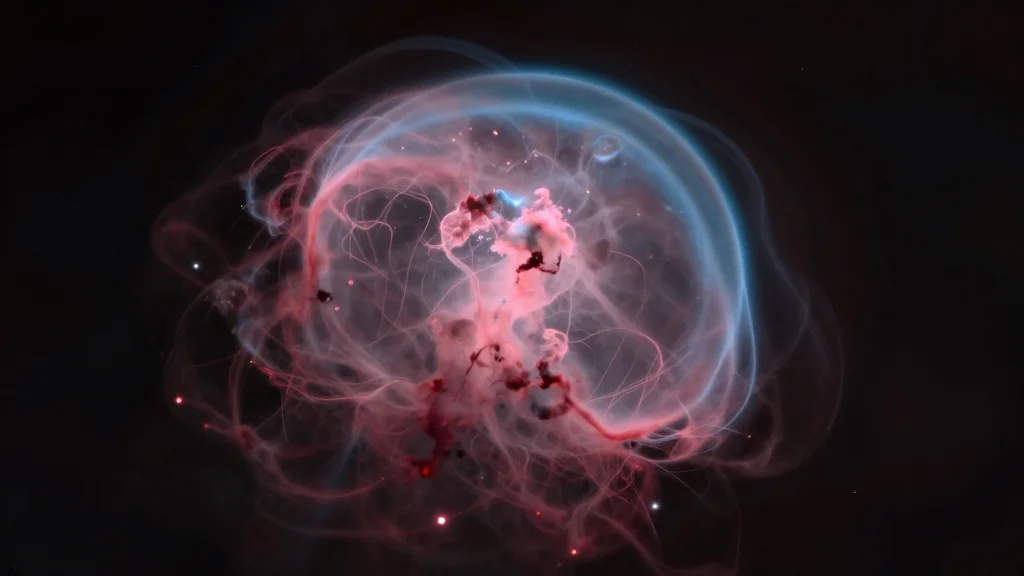
Fermi Mission Uncovers Possible Sibling Supernova Remnants
Why It Matters
It provides the first observational evidence that massive binary stars can each end their lives as supernovae, reshaping models of stellar evolution and cosmic‑ray production. The discovery also offers a natural laboratory for studying particle acceleration mechanisms that power the galaxy’s highest‑energy gamma rays.
Key Takeaways
- •Fermi LAT data uncovered gamma rays from hidden remnant G189.6+3.3.
- •Remnants overlap within 40 light‑years, ~6,000 ly distant.
- •Simulations show <1% chance of random alignment, supporting binary origin.
- •Age gap up to 100,000 years between the two explosions.
- •Provides a rare lab to study supernova‑driven particle acceleration.
Pulse Analysis
The Fermi Gamma‑ray Space Telescope has long been a workhorse for probing the high‑energy universe, but its latest analysis reveals a hidden supernova remnant lurking behind the iconic Jellyfish Nebula. By stacking 16 years of LAT observations, researchers isolated a distinct pion‑decay gamma‑ray signature that can only arise from accelerated protons colliding with interstellar gas. This detection confirms that the faint X‑ray source G189.6+3.3 is not merely a background object but an active particle accelerator sharing the same gas cloud as its brighter neighbor.
Binary massive stars are now understood to be the rule rather than the exception, yet direct evidence of both companions exploding has been elusive. The new study combines precise distance measurements, overlapping shock‑front filaments, and a suite of Monte‑Carlo simulations of a million binary systems. The simulations demonstrate that only a sub‑percent probability exists for the observed spatial coincidence to be random, strongly supporting a physical link. The inferred timeline—an initial explosion 20‑110 kyr ago followed by a second 8‑9 kyr ago—offers a rare glimpse into how mass transfer, orbital dynamics, and supernova “kicks” shape the fate of massive binaries.
Beyond stellar evolution, the dual‑remnant system is a valuable testbed for cosmic‑ray physics. The Jellyfish Nebula is already a candidate PeVatron, capable of accelerating protons to peta‑electron‑volt energies. The presence of a second accelerator nearby could illuminate how supernova remnants transition into PeVatrons and influence the Galactic cosmic‑ray budget. Future observations with next‑generation gamma‑ray observatories and high‑resolution X‑ray telescopes will likely refine the particle spectra and clarify the role of binary‑origin remnants in seeding the Milky Way with the most energetic particles.
Fermi mission uncovers possible sibling supernova remnants
Comments
Want to join the conversation?
Loading comments...