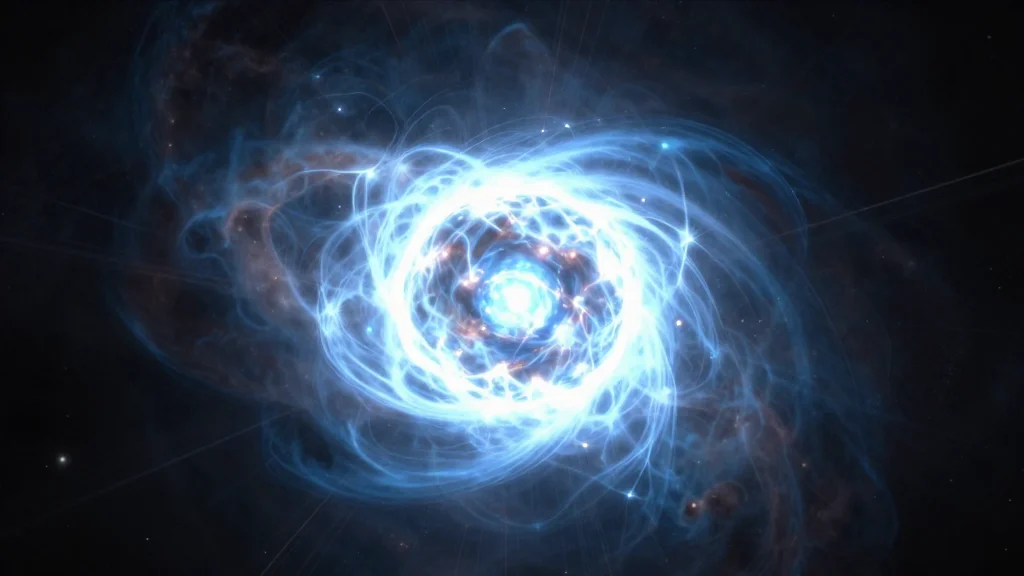
Fermi Telescope Confirms Magnetar Engine Behind Super‑Luminous Supernova SN 2017egm

Why It Matters
The confirmation that magnetars can drive super‑luminous supernovae provides a concrete mechanism for some of the brightest explosions in the universe, closing a gap in high‑energy astrophysics theory. By linking gamma‑ray signatures to the underlying engine, scientists gain a new diagnostic for probing the physics of extreme magnetic fields, particle acceleration, and nucleosynthesis under conditions unattainable on Earth. Beyond pure science, the discovery informs the design of future observatories and the allocation of observation time across the electromagnetic spectrum. It also influences models of cosmic chemical enrichment, as magnetar‑powered explosions may synthesize heavy elements differently from ordinary supernovae, affecting our understanding of galaxy evolution.
Key Takeaways
- •Fermi detects gamma‑ray emission from SN 2017egm, the only positive signal among six nearby super‑luminous supernovae studied.
- •Study led by Fabio Acero (CNRS/University of Paris‑Saclay) provides first direct evidence of a magnetar wind nebula powering the explosion.
- •Guillem Martí‑Devesa (Institute of Space Sciences) emphasizes the new window for gamma‑ray studies of stellar deaths.
- •Theoretical model by Indrek Vurm and Brian Metzger matches observed gamma‑ray flux to magnetar‑driven radiation transport.
- •Future observations with CTA, SMEX, and multi‑messenger facilities will test whether SN 2017egm is typical of magnetar‑powered supernovae.
Pulse Analysis
The Fermi detection marks a watershed for high‑energy transient astronomy, converting a long‑standing theoretical construct into an observable phenomenon. Historically, magnetar models have explained the luminosity excess of super‑luminous supernovae, but lacked empirical validation. By anchoring the gamma‑ray signal to a specific event, the study bridges the gap between theory and observation, setting a benchmark for future surveys.
From a competitive standpoint, the result underscores the value of long‑baseline space observatories. While ground‑based optical surveys continue to discover new super‑luminous supernovae, only a space‑borne gamma‑ray instrument with a wide field of view and multi‑year exposure could capture the faint, delayed high‑energy emission. This advantage may drive renewed investment in all‑sky gamma‑ray monitors, positioning NASA and ESA to lead the next generation of transient detection.
Looking ahead, the discovery invites a re‑examination of the role magnetars play in other astrophysical contexts, such as fast radio bursts and gamma‑ray bursts. If magnetar wind nebulae can sustain gamma‑ray output for years, they could contribute to the diffuse extragalactic gamma‑ray background, a hypothesis that will be testable with upcoming missions. The field now stands at a juncture where coordinated, multi‑messenger campaigns could unlock a holistic view of the most energetic stellar deaths, reshaping models of cosmic energy flow and element formation.
Fermi Telescope Confirms Magnetar Engine Behind Super‑Luminous Supernova SN 2017egm
Comments
Want to join the conversation?
Loading comments...