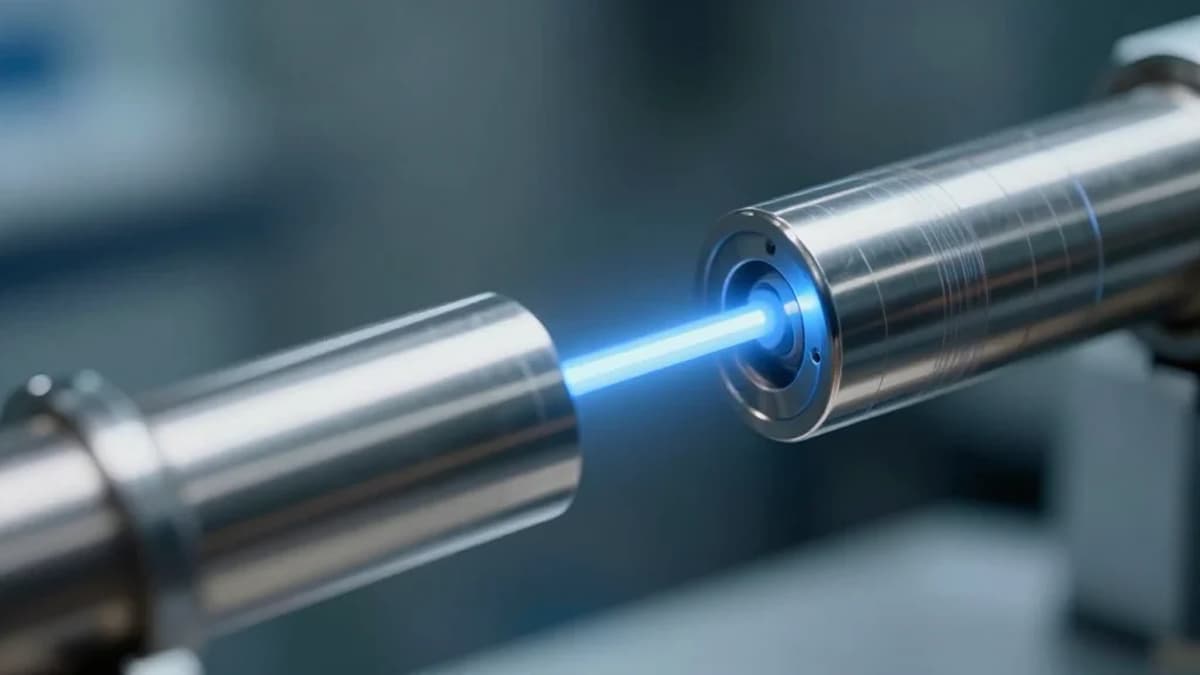
Fermilab’s FAST/IOTA Facility Achieves Major Milestone in Accelerator Research
•March 9, 2026
0
Why It Matters
The breakthrough validates FAST/IOTA as a low‑risk testbed for technologies needed to boost beam power in future particle accelerators, reinforcing U.S. leadership in high‑energy physics.
Key Takeaways
- •First proton beams accelerated in FAST/IOTA facility.
- •Enables testing of high‑intensity beam concepts for PIP‑II.
- •AI algorithms optimize proton source performance.
- •Provides hands‑on training for future accelerator scientists.
- •Supports US leadership in high‑energy physics research.
Pulse Analysis
The successful acceleration of protons in Fermilab’s FAST/IOTA test bed marks the first time the facility has moved beyond its electron‑only heritage. By coupling a low‑voltage proton source with a radio‑frequency quadrupole, the team achieved beam velocities of roughly 7 % of light speed, allowing the IOTA ring to circulate charged particles for the first time. This operational breakthrough validates the design of the new injector and demonstrates that the modular FAST/IOTA architecture can accommodate diverse particle species without disrupting the main accelerator complex.
With proton acceleration now online, FAST/IOTA becomes a critical proving ground for the high‑intensity concepts that will feed into Fermilab’s PIP‑II upgrade and the forthcoming Deep Underground Neutrino Experiment. Researchers can experiment with beam‑stability mitigation, novel magnet configurations, and AI‑driven control loops in a low‑risk environment. Early trials have already shown that machine‑learning optimizers can tune the RFQ parameters faster than traditional manual scans, cutting setup time and improving beam quality. These gains translate directly into higher neutrino fluxes for DUNE, strengthening the United States’ position in global neutrino physics.
Beyond the technical milestones, FAST/IOTA serves as a training platform for the next generation of accelerator scientists. Graduate students and postdoctoral researchers rotate through the facility, gaining experience in hardware design, high‑fidelity simulation, and AI integration—skills that are increasingly demanded by both national labs and industry. The modular nature of the test ring also invites international collaborations, allowing foreign teams to test concepts that could be adopted in future colliders or medical‑therapy accelerators. In this way, the proton breakthrough not only accelerates scientific discovery but also fuels a broader ecosystem of talent and technology worldwide.
Fermilab’s FAST/IOTA facility achieves major milestone in accelerator research
0
Comments
Want to join the conversation?
Loading comments...