Field Demonstration of Trusted-Node QKD over Deployed Single-Mode and Multi-Core Fiber Infrastructure
Companies Mentioned
Why It Matters
The field trial proves that high‑rate QKD can coexist with existing high‑capacity telecom traffic, paving the way for scalable quantum‑secure communications in enterprise and backbone networks.
Key Takeaways
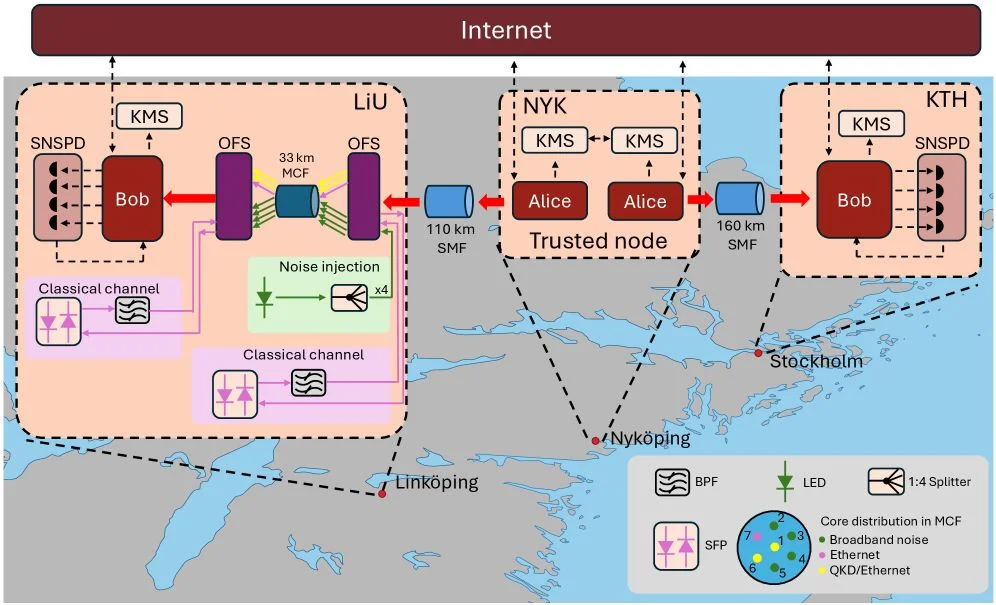
- •303 km QKD link deployed across Sweden using SMF and MCF fibers
- •SNSPDs boosted secret key rate to ~4.75 kbit/s over 110 km
- •Dynamic core switching kept key generation alive amid 10 Gbps traffic
- •KMS buffering prevented key starvation during SNSPD helium‑condensation cycles
Pulse Analysis
Quantum key distribution has moved from laboratory benches to real‑world fiber networks, but scaling the technology to carrier‑grade distances remains a hurdle. The Swedish field demonstration bridges that gap by stitching together 270 km of dark single‑mode fiber with a 33 km multi‑core access link, creating a 303 km trusted‑node chain that runs alongside a live 10 Gbps Ethernet service. By swapping the standard InGaAs detectors for superconducting nanowire single‑photon detectors, the team cut dark counts to below one per second and lifted the secret key rate to nearly 5 kbit/s, a ten‑fold improvement that validates the practicality of high‑performance QKD in existing infrastructure.
The experiment also showcases advanced network‑level features rarely seen in QKD pilots. A Polatis optical switch routed quantum signals between two low‑loss cores of the multi‑core fiber, while automated polarization controllers re‑aligned states within seconds, keeping the key stream alive despite core changes. Key Management Systems buffered the asymmetric generation rates between the 110 km and 160 km spans, preventing key starvation during the 24‑hour helium‑condensation cycle of the SNSPDs. To test payload efficiency, the generated keys encrypted image data using a one‑time pad, and a deep‑learning JPEG AI codec reduced the bits needed per image compared with traditional JPEG 2000, highlighting the importance of compression in quantum‑limited channels.
From a business perspective, the trial demonstrates that quantum‑secure links can be retrofitted onto legacy fiber without disrupting high‑speed data traffic, lowering the barrier for telecom operators and large enterprises to adopt quantum encryption. Trusted‑node architectures, combined with dynamic routing and robust key‑buffering, address the current limitation of point‑to‑point QKD ranges, making nationwide or cross‑border deployments feasible. As standards bodies such as ETSI and ITU begin to codify QKD interfaces, the proven interoperability shown in Sweden positions European vendors to capture a growing market projected to exceed $1 billion by 2030.
Field Demonstration of Trusted-Node QKD over Deployed Single-Mode and Multi-Core Fiber Infrastructure
Comments
Want to join the conversation?
Loading comments...