Fifty Years Since a Simple Equation Described the Chaos of Biology
Companies Mentioned
Why It Matters
May’s insight proved that simple mathematical frameworks can capture complex, real‑world dynamics, fundamentally altering ecological forecasting and inspiring interdisciplinary research that bridges science, literature, and data‑driven decision‑making.
Key Takeaways
- •May's 1976 paper introduced chaos theory to population dynamics
- •Simple equations can generate unpredictable, complex ecological behavior
- •Stoppard's play *Arcadia* drew directly from May's chaos concepts
- •Chaos theory now underpins modern ecological forecasting and data-driven models
- •May's insights continue to shape interdisciplinary research across biology and physics
Pulse Analysis
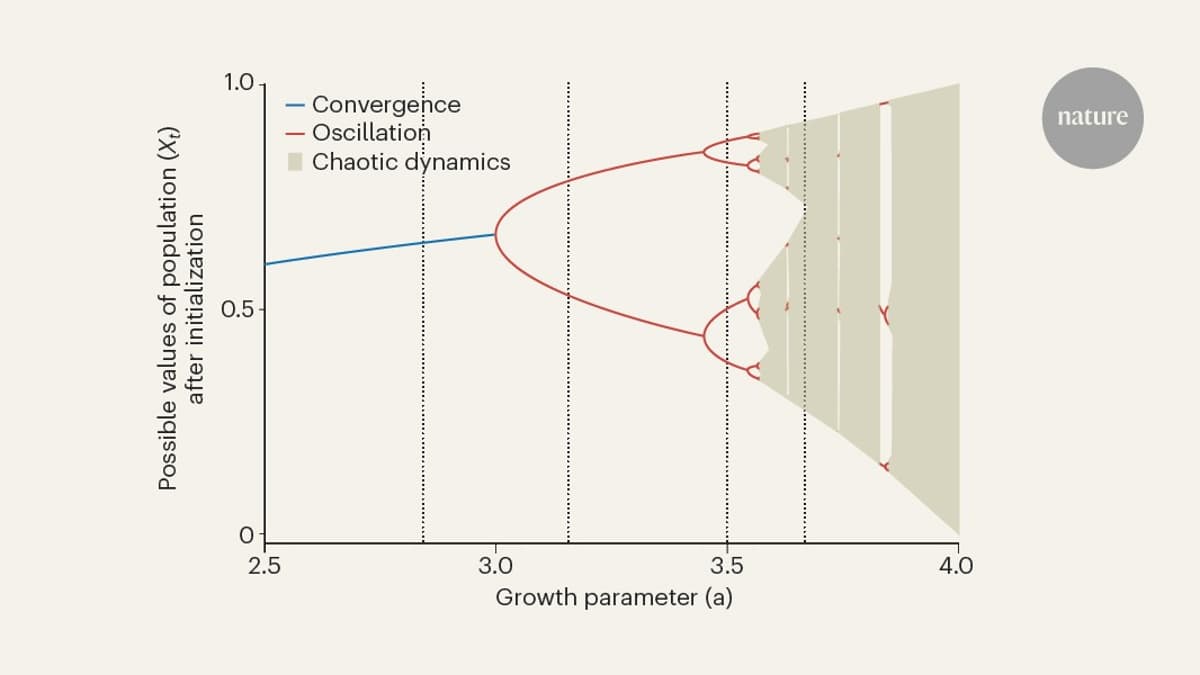
The 1970s witnessed a paradigm shift when Robert May applied a deceptively simple logistic equation to population dynamics, revealing that deterministic systems could exhibit wildly unpredictable trajectories. By showing that a handful of parameters could generate the hallmark sensitivity to initial conditions now synonymous with chaos, May’s work provided a mathematical bridge between abstract theory and tangible ecological phenomena, prompting a flood of research into nonlinear dynamics across the life sciences.
Beyond the laboratory, May’s findings resonated culturally, most famously inspiring Tom Stoppard’s acclaimed play *Arcadia*. The drama weaves together themes of order and disorder, using chaos theory as a narrative device to explore the limits of knowledge and the interplay between past and present. This cross‑disciplinary impact underscored how scientific concepts can permeate literature, education, and public discourse, cementing chaos theory as a touchstone for broader intellectual curiosity.
Decades later, the legacy of May’s simple model endures in cutting‑edge ecological forecasting, epidemiology, and even financial risk assessment. Modern researchers augment his foundational equations with high‑resolution data and machine‑learning techniques, enabling more accurate predictions of species invasions, disease outbreaks, and climate‑driven population shifts. As data availability expands, the principle that minimalistic models can capture complex reality continues to guide interdisciplinary collaborations, ensuring May’s 1976 insight remains a vital tool for navigating today’s chaotic world.
Fifty years since a simple equation described the chaos of biology
Comments
Want to join the conversation?
Loading comments...