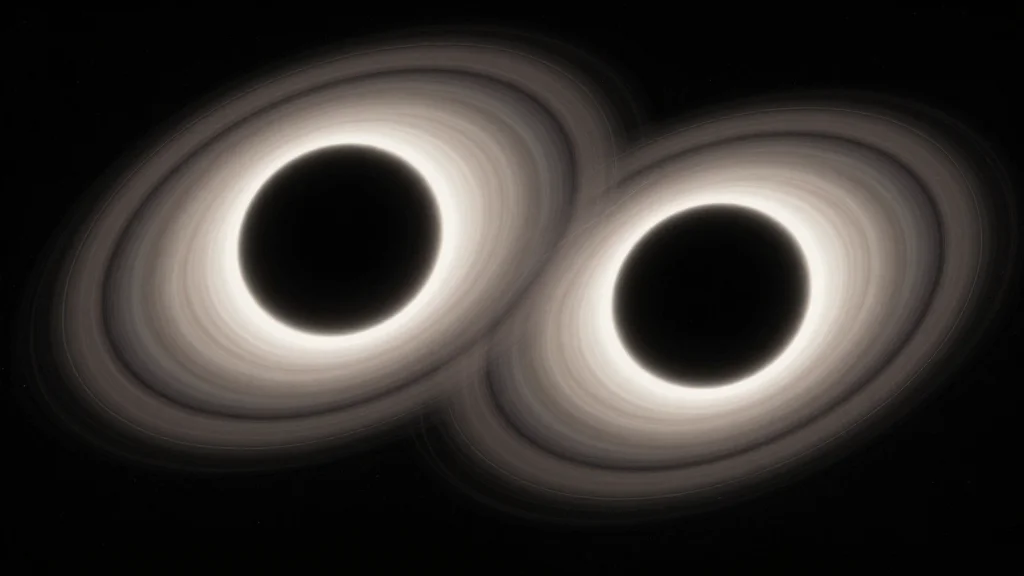
First Close Pair of Supermassive Black Holes Detected
Why It Matters
The system validates predictions about how supermassive black holes coalesce, informing models of galaxy evolution and the low‑frequency gravitational‑wave background that upcoming observatories aim to detect.
Key Takeaways
- •Detected using VLBI radio interferometry at 1.5 billion light‑years.
- •Black holes each weigh ~300 million solar masses, orbiting every 12 years.
- •Separation measured at 7 light‑years, the closest known pair.
- •Confirms models predicting rapid SMBH mergers after galaxy collisions.
- •Provides a new target for low‑frequency gravitational‑wave observatories.
Pulse Analysis
The detection of a tightly bound supermassive black‑hole binary marks a milestone for high‑resolution astronomy. Using very‑long‑baseline interferometry (VLBI), researchers combined radio telescopes across continents to achieve milliarcsecond precision, enough to separate two colossal objects that lie 1.5 billion light‑years away. Such precision was previously reserved for studying distant quasars, but the new observations captured the distinct radio cores of each black hole, confirming their masses at roughly 300 million solar masses and revealing an orbital dance lasting about a dozen years.
Beyond the technical triumph, the binary offers a tangible laboratory for testing theories of galaxy evolution. When galaxies merge, their central black holes are expected to sink toward the core and eventually form a binary system before spiraling together. The observed 7‑light‑year separation aligns with simulations that predict rapid orbital decay after the initial merger phase, shedding light on how often such close pairs should exist in the universe. This insight refines estimates of the stochastic gravitational‑wave background generated by countless merging supermassive black holes throughout cosmic history.
Looking ahead, the newly identified pair becomes a prime target for next‑generation low‑frequency gravitational‑wave detectors such as the Laser Interferometer Space Antenna (LISA) and pulsar‑timing arrays. Continuous monitoring of its orbital parameters could reveal subtle energy loss to gravitational radiation, offering the first direct glimpse of this process at supermassive scales. The discovery therefore not only enriches our understanding of black‑hole dynamics but also paves the way for multi‑messenger astronomy that links electromagnetic observations with future gravitational‑wave signals.
First Close Pair of Supermassive Black Holes Detected
Comments
Want to join the conversation?
Loading comments...