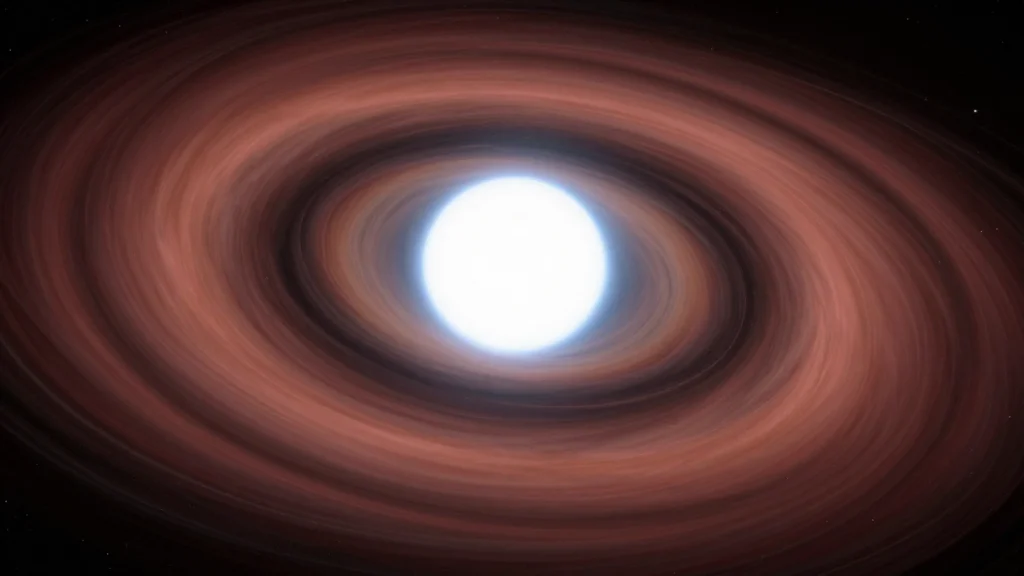
First Ever Live Observation of the Rotation of a Planetary Nursery
Why It Matters
Seeing a planetary nursery spin in real time validates key theories of planet formation and gives researchers a tangible benchmark for modeling disk evolution, accelerating the search for how and where planets emerge.
Key Takeaways
- •ALMA captured real‑time rotation of a protoplanetary disk around star V883 Ori
- •Rotation period measured at roughly 30 years, matching theoretical models
- •Observations reveal spiral density waves that may seed future planets
- •Findings validate disk‑instability scenario for rapid giant‑planet formation
Pulse Analysis
The live observation of V883 Ori’s rotating disk marks a milestone for radio astronomy and planetary science. By leveraging ALMA’s unprecedented resolution at millimeter wavelengths, researchers could track gas motion across a span of months, translating subtle Doppler shifts into a clear picture of the disk’s spin. This level of detail—once only accessible through computer simulations—provides a concrete data set that anchors theoretical frameworks about angular momentum transport and accretion processes in nascent planetary systems.
Beyond confirming that protoplanetary disks rotate, the data expose spiral density waves that ripple through the gas and dust. Such structures are thought to act as nurseries for planetesimals, the building blocks of planets, by concentrating material and fostering rapid growth. The measured rotation period of about three decades aligns with predictions from both core‑accretion and disk‑instability models, suggesting that massive planets could form far more quickly than previously assumed. This insight reshapes timelines for gas‑giant formation and informs the interpretation of exoplanet demographics observed by missions like TESS and JWST.
The broader impact reaches into future observational campaigns and commercial space ventures. With a proven method for real‑time disk monitoring, astronomers can now target a wider sample of young stars to map the diversity of formation pathways. Industries developing high‑frequency radio instrumentation stand to benefit from the heightened demand for ultra‑stable, high‑resolution arrays. Ultimately, the ability to watch a planetary nursery in action brings the field one step closer to answering fundamental questions about the origins of Earth‑like worlds and the frequency of habitable planets across the galaxy.
First Ever Live Observation of the Rotation of a Planetary Nursery
Comments
Want to join the conversation?
Loading comments...