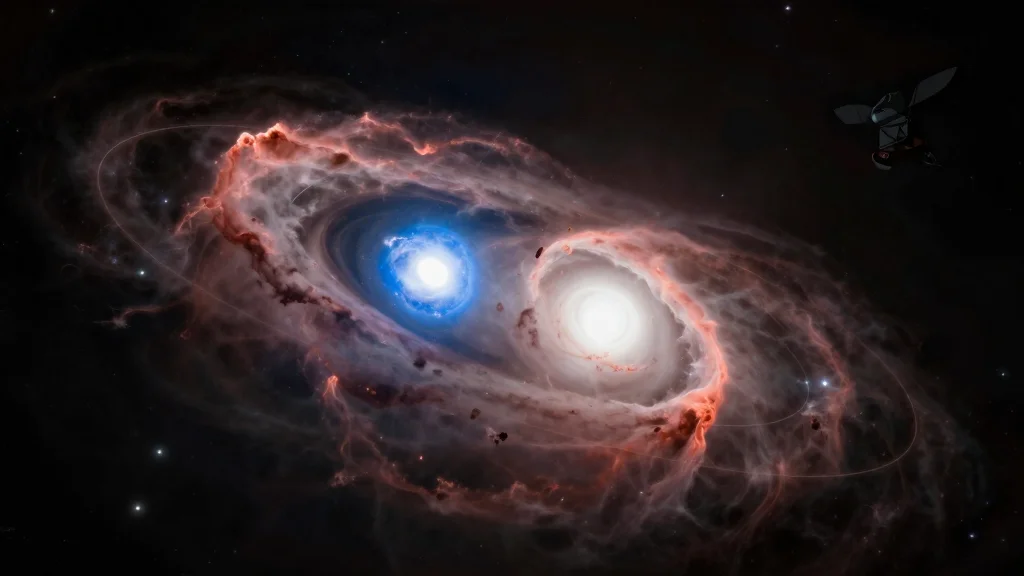
First Outbursting Hot Subdwarf Binary Discovered
Why It Matters
The finding shows hot subdwarf binaries can trigger accretion‑disk instabilities, linking them to classic cataclysmic variables and refining models of stellar mergers and potential supernova progenitors.
Key Takeaways
- •ZTF J0007+4804 shows SU UMa‑type dwarf nova outbursts
- •Orbital period measured at 1.81 hours (108.72 minutes)
- •Mass transfer rate estimated at 1.6 × 10⁻¹¹ M☉ yr⁻¹
- •System will likely merge in ~226 million years via gravitational waves
- •First hot subdwarf‑white dwarf binary observed with periodic outbursts
Pulse Analysis
The discovery of ZTF J0007+4804 marks the first confirmed hot subdwarf–white dwarf binary that undergoes dwarf‑nova outbursts, a phenomenon previously seen only in cataclysmic variables with main‑sequence donors. Hot subdwarfs—compact, helium‑burning stars—are already scarce, and pairing one with an accreting white dwarf adds a new dimension to binary evolution studies. 81‑hour orbital period and a subdwarf temperature of 23,500 K, astronomers have opened a window onto a class of objects that bridges subdwarf binaries and classic nova systems. The team leveraged more than 2,200 ZTF exposures and over 47,000 TESS measurements to map the light curve in unprecedented detail.
The data reveal SU UMa‑type dwarf‑nova behavior, with regular outbursts every nine days and longer superoutbursts lasting one to two weeks. 48 M☉ white dwarf. This is the fourth known subdwarf‑WD system undergoing Roche‑lobe overflow, underscoring how high‑cadence surveys are reshaping our census of exotic binaries.
Modeling suggests the binary will coalesce in about 226 million years as gravitational‑wave radiation shrinks the orbit, likely producing a massive, hydrogen‑deficient white dwarf. A thermonuclear explosion cannot be ruled out, raising the possibility that such systems contribute to the population of underluminous type Ia supernovae. The detection also provides a natural laboratory for testing angular‑momentum loss mechanisms and disk instability theory in a regime where the donor star is a hot subdwarf rather than a main‑sequence star. As space‑based time‑domain missions expand, more of these rare objects may emerge, refining predictions for future gravitational‑wave observatories.
First outbursting hot subdwarf binary discovered
Comments
Want to join the conversation?
Loading comments...