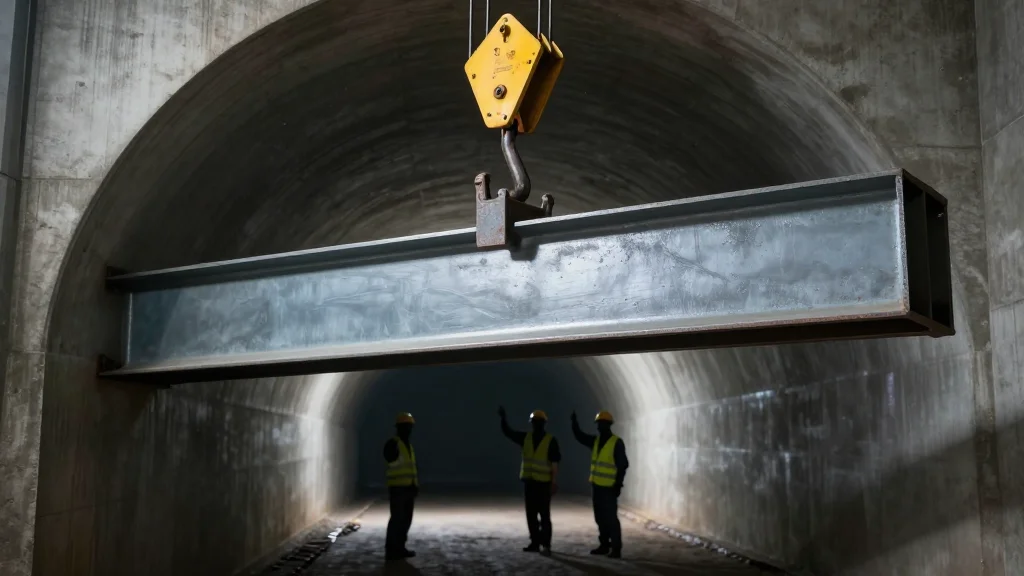
First Steel Beams for DUNE Start to Be Lowered Underground
Why It Matters
The milestone accelerates DUNE’s timeline, strengthening trans‑Atlantic scientific collaboration and expanding the global capability to study neutrino properties, a key frontier in particle physics.
Key Takeaways
- •4,500 tonnes of steel beams lowered 1.5 km underground at SURF.
- •Two detector modules each the size of a five‑storey building.
- •CERN provides prototype detectors and massive cryostats for DUNE.
- •Neutrinos travel 1,300 km from Fermilab to SURF for precise imaging.
- •US DOE labs supply superconducting magnets for CERN’s HL‑LHC upgrade.
Pulse Analysis
The Deep Underground Neutrino Experiment (DUNE) represents one of the most ambitious efforts to decode the elusive behavior of neutrinos, particles that permeate the universe yet interact only weakly with matter. By positioning massive liquid‑argon detectors deep beneath the Black Hills of South Dakota, scientists aim to capture high‑resolution snapshots of neutrino collisions generated at Fermilab. This underground setting dramatically reduces background noise, allowing researchers to reconstruct three‑dimensional interaction maps that could reveal CP violation and shed light on why matter dominates the cosmos.
The recent lowering of 4,500 tonnes of steel beams marks a tangible step toward realizing DUNE’s dual‑module design. Each module, comparable in volume to a five‑storey building, will house cryostats that keep argon at ultra‑cold temperatures, a technology largely developed by CERN. The logistical feat of transporting and installing these beams 1.5 km below ground underscores the engineering prowess required for next‑generation particle experiments. CERN’s involvement extends beyond hardware; its expertise in detector prototyping accelerates the integration of cutting‑edge readout systems, ensuring the experiment meets its stringent sensitivity goals.
Beyond scientific discovery, DUNE strengthens the strategic partnership between the United States and Europe. The collaboration leverages U.S. Department of Energy laboratory capabilities—such as superconducting magnet production for the High‑Luminosity Large Hadron Collider—while providing CERN with a platform to test large‑scale cryogenic technologies. Successful operation of DUNE could catalyze new applications in medical imaging, nuclear security, and quantum sensing, illustrating how fundamental research drives broader technological innovation.
First steel beams for DUNE start to be lowered underground
Comments
Want to join the conversation?
Loading comments...