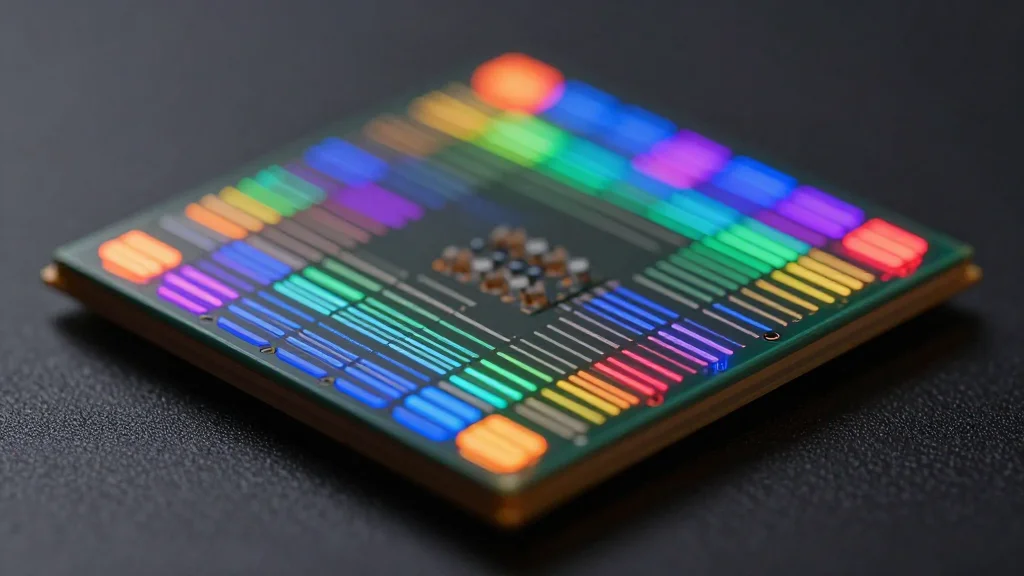
Five Phases of Localization Physics Observed in a Single Quantum System
Why It Matters
The discovery expands the known taxonomy of wave localization, enabling new quantum‑simulation strategies and informing the design of disorder‑engineered photonic and electronic materials.
Key Takeaways
- •Five localization phases realized on a single photonic Floquet platform
- •Critical phase shows fractal, multifractal wave dynamics
- •Coexisting phases reveal simultaneous extended and localized behavior
- •Programmable optical loop enables real‑time phase switching via quasiperiodic controls
- •Findings expand mobility‑edge research and quantum simulation capabilities
Pulse Analysis
Anderson’s 1958 insight that disorder can trap waves laid the foundation for localization theory, traditionally divided into extended and localized regimes. Over the decades, theorists proposed a third, critical phase characterized by fractal wavefunctions and anomalous transport, but experimental access remained elusive. The recent study bridges that gap, confirming that the critical phase not only exists but can coexist with the classic states, suggesting a far richer phase diagram than previously imagined.
The breakthrough hinges on a programmable photonic Floquet platform that circulates laser pulses through an optical loop, applying site‑dependent spin rotations, nearest‑neighbor hopping, and adjustable onsite potentials each round trip. By fine‑tuning two independent quasiperiodic controls, researchers can navigate the system across five distinct regimes: pure extended, pure localized, pure critical, and two hybrid states where extended‑localized or localized‑critical characteristics appear simultaneously. Real‑time extraction of light after each loop provides a high‑resolution snapshot of wave‑packet evolution, allowing direct identification of ballistic spreading, confinement, or oscillatory fractal dynamics.
Beyond its immediate scientific merit, the platform opens new avenues for quantum simulation of disordered systems, offering a controllable environment to probe mobility edges, multifractality, and non‑equilibrium dynamics. Such capabilities could inform the engineering of robust photonic circuits, topological devices, and even quantum‑information processors that exploit disorder for protection against decoherence. As researchers extend the approach to higher dimensions and interacting particles, the findings are poised to reshape our understanding of transport phenomena across condensed‑matter, optics, and emerging quantum technologies.
Five phases of localization physics observed in a single quantum system
Comments
Want to join the conversation?
Loading comments...