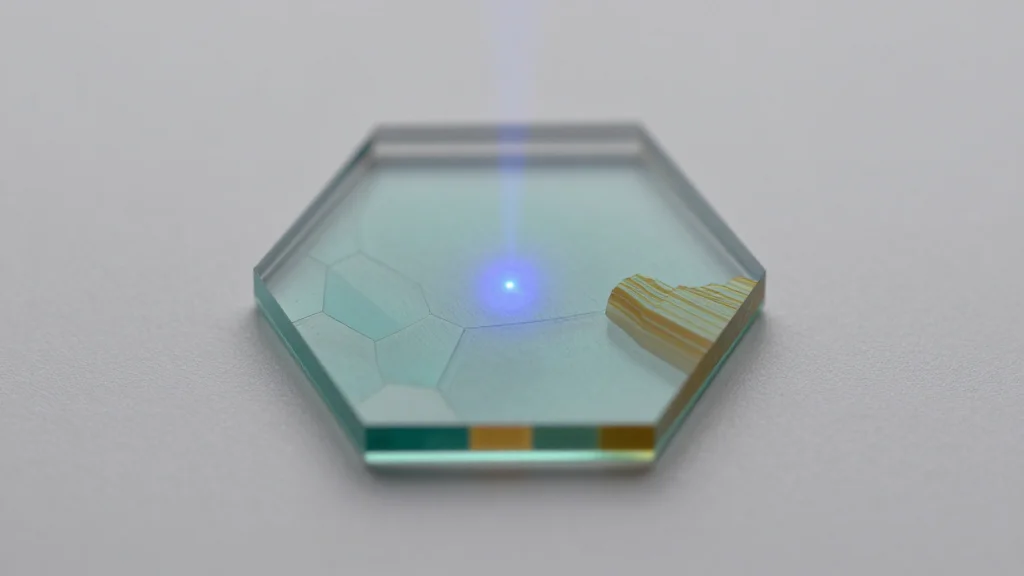
'Flawless on the Outside, Flipped Within': Detecting Hidden Defects in 2D Dielectrics with Light
Why It Matters
The ability to map invisible antiparallel domains across wafer‑scale hBN films accelerates material optimization, reducing yield losses in advanced electronics and quantum hardware. Rapid, optical quality assessment will be critical as 2D dielectrics become foundational layers in AI chips and photonic integrated circuits.
Key Takeaways
- •Interferometric SHG imaging reveals antiparallel domains in hBN films.
- •Technique quantifies crystal inhomogeneity via 180° phase contrast.
- •Enables rapid, large‑area quality assessment beyond TEM and Raman limits.
- •Correlates SHG intensity with Raman data for crystallinity metrics.
- •Supports optimization of 2D material growth for next‑gen devices.
Pulse Analysis
The semiconductor industry is rapidly turning to two‑dimensional (2D) crystals as building blocks for ultra‑thin, high‑performance devices. Hexagonal boron nitride (hBN) stands out for its wide bandgap and exceptional insulating properties, making it the preferred protective layer for graphene, transition‑metal dichalcogenides and emerging quantum‑well structures. However, when hBN is grown over large substrates, microscopic antiparallel domains—regions where the crystal lattice flips orientation—can form without any surface indication. These hidden reversals disrupt charge transport and optical response, posing a silent reliability risk for AI accelerators, photonic chips and quantum processors that demand defect‑free dielectrics.
The team led by Prof. Sunmin Ryu tackled this blind spot with interferometric second‑harmonic generation (SHG) imaging, a nonlinear optical technique that doubles the frequency of incident light. By introducing a calibrated reference beam and measuring the phase offset between the sample‑generated SHG and the reference, the system resolves a 180‑degree phase shift that uniquely marks antiparallel domains. Unlike transmission electron microscopy, which requires destructive sample preparation, or Raman spectroscopy, which cannot directly differentiate domain polarity, interferometric SHG delivers rapid, non‑contact mapping over centimeters of film. The method also quantifies the degree of destructive interference, turning a qualitative observation into a metric of crystal uniformity.
From a commercial perspective, this optical diagnostic opens a pathway to inline quality control in hBN production lines, cutting the time and cost associated with post‑process inspection. Manufacturers can now correlate growth parameters—temperature, precursor flow, substrate choice—with measurable SHG contrast, enabling data‑driven process optimization. As 2D dielectrics become integral to next‑generation AI chips, photonic interconnects and scalable quantum architectures, the ability to guarantee wafer‑scale uniformity will directly influence device yield and performance. The technique’s scalability also suggests broader applicability to other 2D insulators, positioning it as a standard tool in the emerging 2D‑materials supply chain.
'Flawless on the outside, flipped within': Detecting hidden defects in 2D dielectrics with light
Comments
Want to join the conversation?
Loading comments...