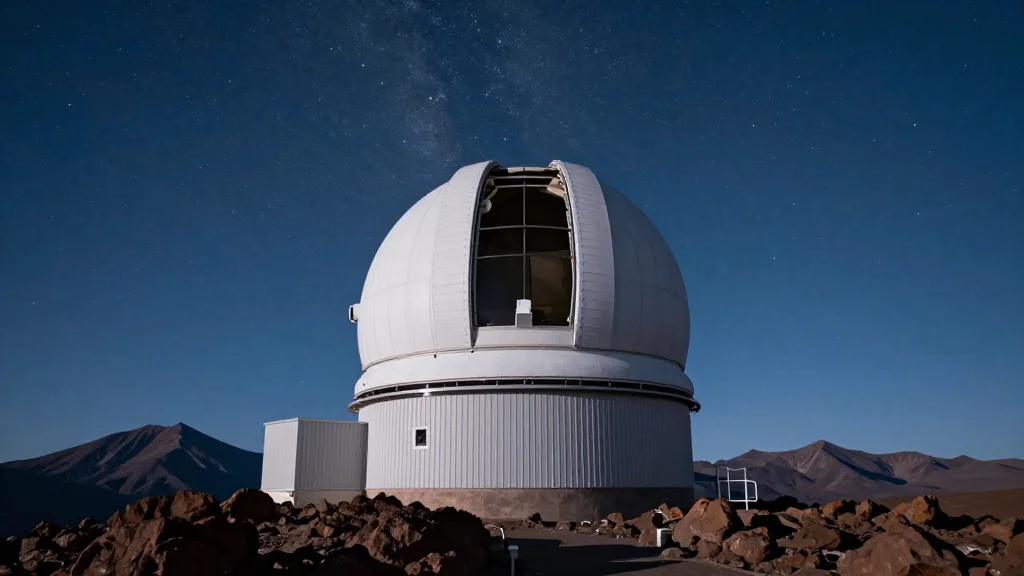
Fred Young Submillimeter Telescope Begins Operations on Chile's Cerro Chajnantor

Why It Matters
FYST expands humanity’s ability to observe the universe in a wavelength band that reveals the hidden processes of star formation, galaxy assembly and the large‑scale structure shaped by dark matter. Its wide‑field, high‑throughput design complements existing high‑resolution facilities, enabling statistical studies that were previously impractical. By delivering unprecedented submillimeter sky maps, the telescope will sharpen cosmological models, inform theories of dark energy, and guide future missions that aim to probe the early universe. The project also exemplifies a successful multinational academic partnership, demonstrating how shared infrastructure can accelerate scientific discovery while training the next generation of astronomers across the United States, Europe, Canada and Chile. The collaborative framework may serve as a template for future large‑scale observatories in an era where funding and expertise are increasingly distributed globally.
Key Takeaways
- •FYST inaugurated on Cerro Chajnantor, Chile, after 34 years of planning
- •More than 100 scientists and dignitaries attended the opening ceremony
- •Wide‑field submillimeter design enables rapid sky mapping and "celestial cinematography"
- •Project involves Cornell, German universities, Max Planck Institute, Canadian consortium and Chilean astronomers
- •Early science will target dark energy, dark matter, galaxy formation and the early universe
Pulse Analysis
The Fred Young Submillimeter Telescope arrives at a pivotal moment for ground‑based astronomy. While ALMA has set the benchmark for resolution in the submillimeter regime, its narrow field of view limits its ability to conduct large‑area surveys. FYST flips that paradigm, trading some angular resolution for an unprecedented survey speed that can capture the faint, diffuse emission from dust‑enshrouded galaxies across vast swaths of sky. This capability fills a critical gap in the observational toolbox, allowing cosmologists to build statistically robust samples needed to test competing dark energy models.
Historically, submillimeter astronomy has been constrained by technology and site selection. The decision to locate FYST on Cerro Chajnantor—one of the driest, highest sites on Earth—leverages the same atmospheric advantages that made the Atacama plateau a hub for millimeter astronomy. The telescope’s optical innovation, a wide‑field design rarely seen at these wavelengths, reflects a broader trend toward multiplexed instrumentation that can deliver “big data” sets for astrophysics. As data pipelines mature, the community will likely see a surge in machine‑learning‑driven analyses, accelerating the pace at which theoretical models are refined.
Looking ahead, FYST’s success could influence funding agencies to prioritize collaborative, multi‑institutional projects that combine niche expertise with shared infrastructure. The model—anchored by a leading U.S. university but co‑managed with European and Canadian partners—demonstrates a scalable approach to tackling the high costs of next‑generation observatories. If FYST delivers on its promise of rapid, high‑sensitivity mapping, it may pave the way for even larger submillimeter survey facilities, potentially informing the design of space‑based missions that aim to extend the reach of “celestial cinematography” beyond Earth’s atmosphere.
Fred Young Submillimeter Telescope Begins Operations on Chile's Cerro Chajnantor
Comments
Want to join the conversation?
Loading comments...