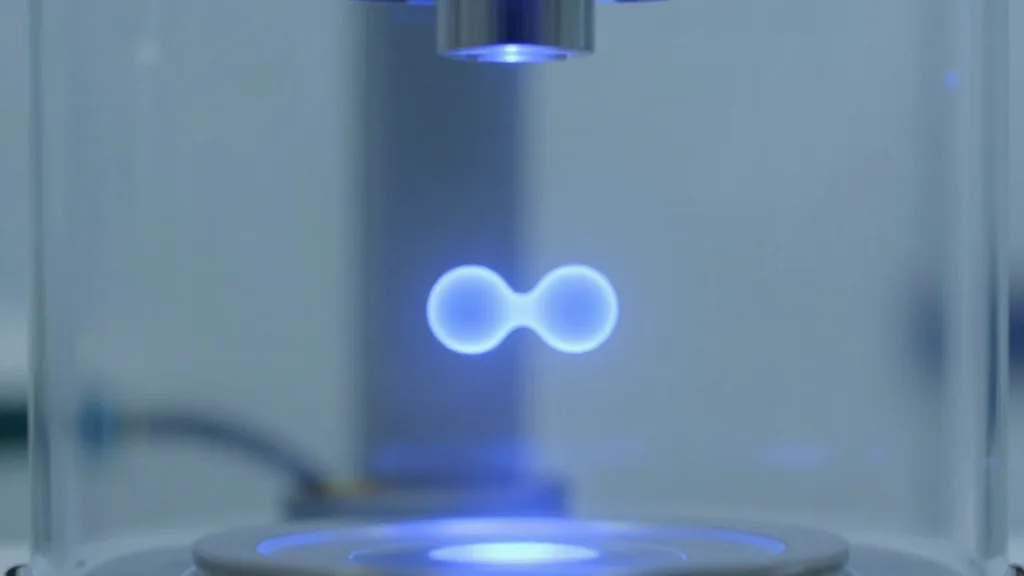
French Team Directly Images Cooper‑Pair “Dance” In Superconductor Mimic

Why It Matters
Directly visualizing Cooper‑pair interactions provides the missing experimental anchor for theories that go beyond BCS, a cornerstone of condensed‑matter physics for seven decades. By exposing how pairs influence each other, the work opens a concrete route to design materials where superconductivity persists at higher, possibly ambient, temperatures. Such breakthroughs would dramatically reduce energy losses in electrical grids, enable loss‑less interconnects for data centers, and accelerate the development of quantum devices that rely on superconducting circuits. Beyond applications, the study exemplifies the power of quantum‑simulation platforms—ultracold atoms—to probe phenomena that are otherwise inaccessible in solid‑state systems. The ability to image and manipulate individual pairs in real time could spawn a new subfield focused on “pair dynamics,” reshaping curricula and research funding priorities across physics departments worldwide.
Key Takeaways
- •French CNRS team directly imaged Cooper‑pair dynamics in an ultracold Fermi gas.
- •Observed coordinated motion of paired atoms, contradicting independent‑pair assumption of BCS theory.
- •Study published April 15, 2026 in Physical Review Letters; collaboration includes Simons Foundation's Flatiron Institute.
- •Quotes: Tarik Yefsah (CNRS) and Shiwei Zhang (Flatiron Institute) highlight missing interaction in classic theory.
- •Findings could guide the design of room‑temperature superconductors, impacting energy and quantum tech.
Pulse Analysis
The imaging breakthrough represents a paradigm shift akin to the first direct observations of electron spin or the Higgs boson. For decades, superconductivity research has been hamstrung by the inability to watch Cooper pairs in action; theory has proceeded on indirect evidence and mathematical conjecture. By turning a cold‑atom gas into a high‑fidelity analog, the French team has provided a tangible testbed for new models that incorporate pair‑pair coupling. This could catalyze a wave of theoretical papers that re‑examine long‑standing assumptions about the superconducting order parameter.
Historically, each major advance in superconductivity—BCS theory, the discovery of high‑Tc cuprates, iron‑based superconductors—has spurred a re‑allocation of research funding and a surge in patent activity. If the observed dynamics can be replicated in real materials, we may see a similar influx of venture capital targeting “pair‑engineered” compounds. Companies working on quantum computing hardware, which already rely on low‑temperature superconducting qubits, stand to benefit from materials that operate at higher temperatures, reducing cooling costs and system complexity.
In the short term, the most immediate impact will be on the academic community. Graduate programs will likely add courses on quantum simulation of many‑body systems, and funding agencies may prioritize proposals that leverage ultracold platforms to solve condensed‑matter puzzles. Over the next five years, the convergence of experimental imaging, advanced simulation, and materials synthesis could finally bridge the gap between theory and application, moving the dream of room‑temperature superconductivity from speculative to engineering reality.
French Team Directly Images Cooper‑Pair “Dance” in Superconductor Mimic
Comments
Want to join the conversation?
Loading comments...