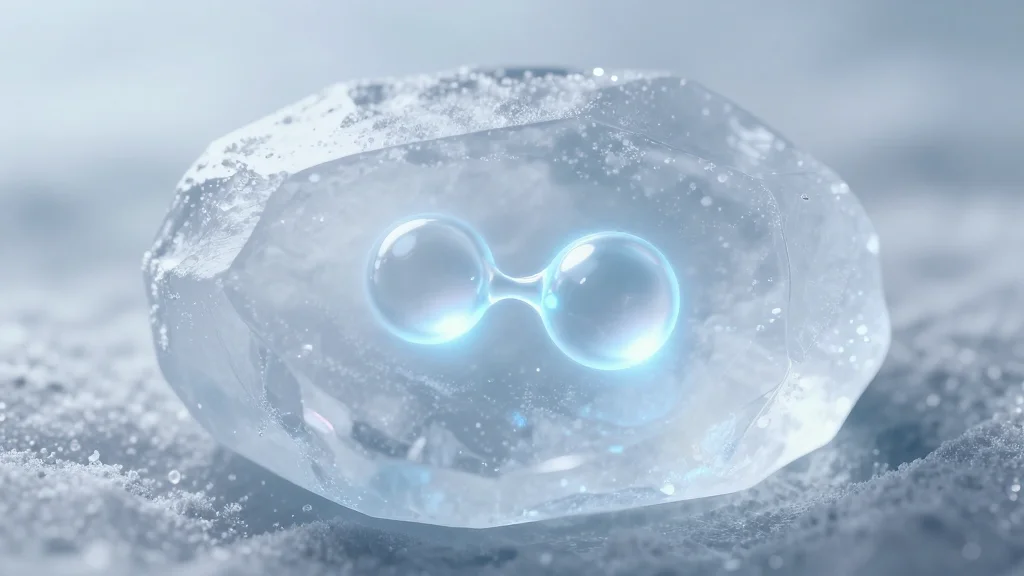
Frozen in Dry Ice, Hydrogen Reveals a Surprisingly Simple Way to Control Quantum Behavior
Why It Matters
Controlling hydrogen’s spin without expensive equipment could boost DOE’s hydrogen‑energy efficiency and provide a scalable route to more stable qubits, while also refining astrochemical temperature models.
Key Takeaways
- •Dry‑ice crystals dictate which ortho‑H₂ spin states convert to para‑H₂
- •Adding nitrogen dioxide relaxes crystal rules, enabling full ortho‑to‑para conversion
- •Spin‑controlled hydrogen could improve DOE’s storage efficiency and heat management
- •Protected nuclear spins offer a simpler path to stable quantum‑memory qubits
- •Technique may validate comet temperature estimates by reproducing ortho/para ratios
Pulse Analysis
The ability to steer quantum states has long depended on powerful magnets or exotic catalysts, limiting practical deployment. In a recent Physical Review Letters paper, University of Maryland researchers demonstrated that simply freezing H₂ in dry‑ice crystals imposes symmetry‑based selection rules that protect specific nuclear‑spin configurations. By varying the host crystal’s geometry, they can either block or permit the ortho‑to‑para conversion, a process traditionally controlled by high‑field NMR techniques. This material‑design approach sidesteps costly infrastructure, making quantum‑state engineering accessible to a broader range of laboratories.
For the energy sector, the discovery could transform hydrogen‑fuel logistics. Ortho‑hydrogen releases heat when it relaxes to para‑hydrogen, a challenge for storage tanks that must manage temperature spikes. By enriching fuel with spin states that remain locked in the ortho form, operators can reduce unwanted heat generation and improve overall storage density. The U.S. Department of Energy, which is investing heavily in hydrogen as a clean‑energy carrier, may adopt spin‑tailored hydrogen to enhance safety and efficiency, potentially lowering the cost curve for large‑scale deployment.
Beyond energy, the findings resonate with quantum information science and astrochemistry. Stable nuclear‑spin qubits could serve as low‑error memory elements, offering a simpler platform than superconducting circuits or trapped ions. Meanwhile, NASA’s comet‑temperature estimates rely on ortho‑para ratios in water ice; reproducing those ratios in the lab with controlled H₂ provides a benchmark to validate or revise existing models. As the researchers extend the method to methane and other fuels, the work lays a versatile foundation for both next‑generation quantum devices and more accurate space‑science measurements.
Frozen in dry ice, hydrogen reveals a surprisingly simple way to control quantum behavior
Comments
Want to join the conversation?
Loading comments...