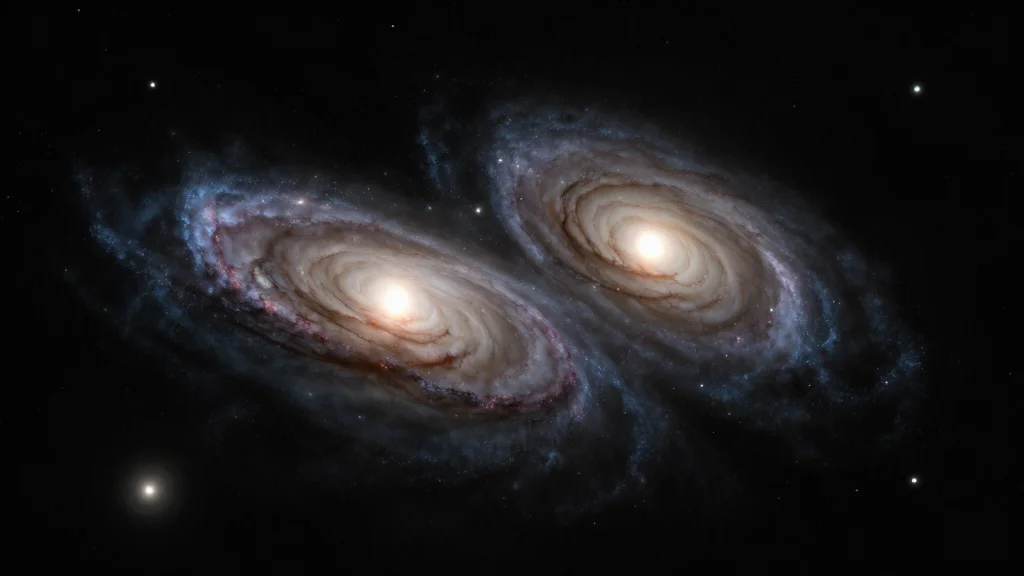
Galactic Collision May Have Reset Milky Way Disk 11 Billion Years Ago
Why It Matters
Re‑dating the Gaia‑Sausage‑Enceladus event reshapes our timeline for the Milky Way’s structural evolution and refines models of how mergers drive star‑formation bursts in spiral galaxies.
Key Takeaways
- •Simulations suggest Milky Way disk rebuilt after 11 billion‑year merger.
- •Gaia‑Sausage‑Enceladus event dated earlier than prior estimates.
- •Star‑cluster formation spike aligns with collision‑induced gas compression.
- •Disk “spin‑up” marks recovery, not initial formation.
- •JWST and ALMA will test early‑disk formation models.
Pulse Analysis
Galaxy collisions are a fundamental engine of cosmic evolution, capable of reshaping the morphology of massive spirals in a single event. For decades astronomers have debated whether the Milky Way’s thin, rotating disk formed gradually or was reset by a violent merger. The Gaia mission’s discovery of a distinct stellar population hinted at a massive accretion, but the precise timing remained fuzzy, leaving a gap in our understanding of how the Galaxy’s present‑day structure emerged.
The new research leverages the high‑resolution Auriga suite of simulations, which model the growth of Milky Way‑like galaxies under a variety of merger histories. By reproducing the observed surge in globular‑cluster formation and the kinematic signatures of the Gaia‑Sausage‑Enceladus debris, the authors pinpoint the collision to about 11 billion years ago—significantly earlier than many prior estimates. Their analysis shows that the disk’s apparent spin‑up coincides with the post‑merger re‑assembly of stellar orbits, suggesting that the current disk is a reborn structure rather than an uninterrupted relic.
This revised chronology has ripple effects across astrophysics. It forces galaxy‑formation models to account for rapid disk regeneration after major impacts and underscores the role of mergers in triggering star‑burst episodes. Upcoming observations with the James Webb Space Telescope and the Atacama Large Millimeter/submillimeter Array will probe distant, disk‑building galaxies at comparable epochs, offering a direct test of the simulation‑driven scenario. As data converge, the Milky Way will serve as a benchmark for decoding the complex interplay between collisions, star formation, and disk survival in the broader universe.
Galactic collision may have reset Milky Way disk 11 billion years ago
Comments
Want to join the conversation?
Loading comments...