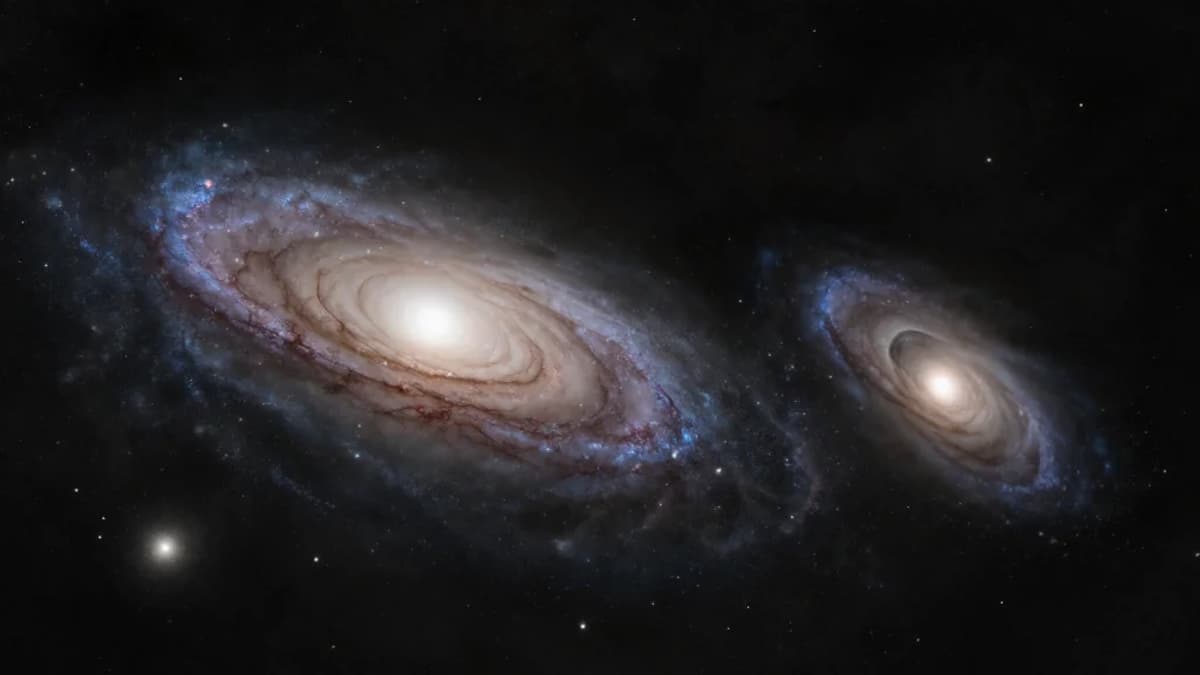
Galaxy-Group Motion Suggests Slower Expansion in Our Cosmic Neighborhood
•March 11, 2026
0
Why It Matters
If local expansion is slower than previously thought, the discrepancy between early‑universe and late‑universe measurements shrinks, reshaping cosmological models and dark‑matter assumptions.
Key Takeaways
- •Local Hubble constant measured at ~64 km/s/Mpc.
- •Method uses galaxy group dynamics, not supernovae.
- •Masses of groups explained without large dark‑matter halos.
- •Centaurus A group binary with M83, not centered.
- •Findings may narrow Hubble tension and refine dark matter estimates.
Pulse Analysis
The persistent Hubble tension—differences between early‑universe and late‑universe expansion rates—has driven a wave of novel measurement techniques. While supernovae and Cepheid variables have dominated local distance ladders, the new approach treats galaxy groups as test particles embedded in the expanding fabric of space. By modeling the tug‑of‑war between mutual gravity and the Hubble flow, researchers extract both group masses and the expansion rate, arriving at a value that aligns more closely with the cosmic‑microwave‑background benchmark.
Centaurus A/M83 and M81/M82 provide complementary laboratories. In the Centaurus A system, the dominant elliptical galaxy shares a binary relationship with M83, overturning the assumption that Centaurus A alone anchors the group’s mass. Meanwhile, the M81 group retains a planar configuration that tilts relative to larger‑scale structures, offering a geometric cross‑check on dynamical models. Crucially, both groups appear to require minimal dark‑matter halos to reproduce observed motions, challenging simulation‑driven expectations and hinting that local dark‑matter density may be lower than standard models predict.
Looking ahead, the method’s scalability promises broader tests across the nearby universe. Upcoming spectroscopic campaigns such as 4MOST will deliver precise redshifts and distances for dozens of groups, enabling a statistical assessment of the Hubble constant and dark‑matter distribution beyond the Local Group. If the slower expansion trend holds, it could reconcile disparate cosmological probes, reduce the need for exotic physics, and refine the parameters that underpin the standard ΛCDM model.
Galaxy-group motion suggests slower expansion in our cosmic neighborhood
0
Comments
Want to join the conversation?
Loading comments...