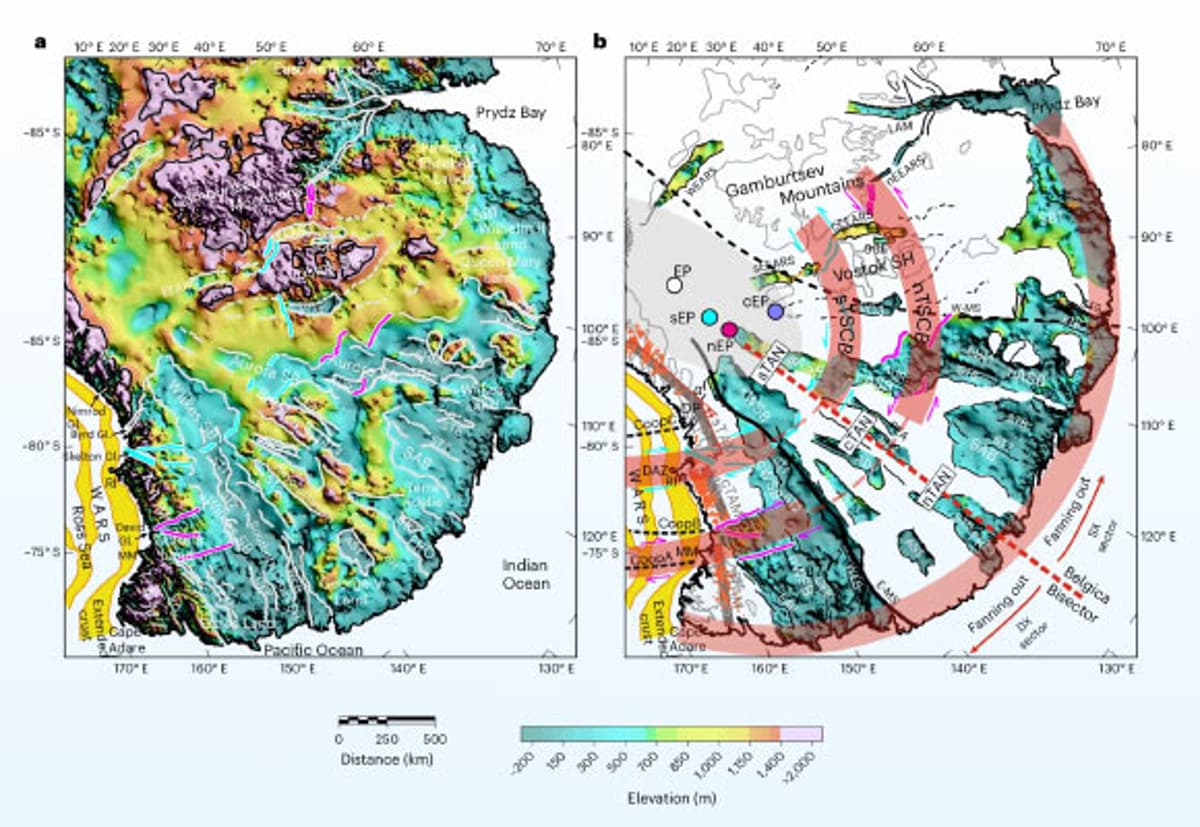
Geoscientists Find Vast Fan-Shaped Structure Beneath Antarctica’s Ice
Why It Matters
The discovery reveals a continent‑scale tectonic feature that controls subglacial basin distribution, directly affecting ice flow and potential sea‑level rise. It also offers new clues about the ancient processes that fragmented Gondwana, informing both geologic history and climate‑impact models.
Key Takeaways
- •EAFBP links Wilkes, Aurora basins and Lake Vostok region
- •Rotational extension shaped East Antarctica's fan-like subglacial province
- •Structure may have guided Gondwana breakup and Antarctica‑Australia separation
- •Bedrock geometry influences current ice flow and climate‑change vulnerability
Pulse Analysis
The identification of the East Antarctic Fan‑Shaped Basin Province marks a watershed moment in polar geoscience. By integrating high‑resolution seismic profiles, satellite‑derived gravity anomalies and radio‑echo sounding, the international team mapped a contiguous, fan‑shaped topographic low that stretches from Prydz Bay to the Transantarctic Mountains. This structural coherence challenges the long‑standing view of East Antarctica as a patchwork of isolated basins and suggests a unified tectonic history that can be traced back to the late Precambrian‑early Paleozoic era.
At the heart of the new model is distributed rotational extension, a rare form of crustal stretching where material spreads outward from a central pivot, creating a fan‑like arrangement of basins. Such a mechanism aligns with the breakup of the supercontinent Gondwana, offering a plausible driver for the separation of Antarctica from Australia and the opening of the Southern Ocean. The scale of the EAFBP—potentially the largest known example of rotational extension—provides a natural laboratory for testing theories of continental rifting and mantle dynamics, with implications that extend to other ancient orogens worldwide.
Beyond academic intrigue, the fan‑shaped bedrock exerts a tangible influence on present‑day ice dynamics. Subglacial basins and lakes, sculpted by the underlying geology, channel ice flow and modulate basal friction, factors that are critical for predicting the Antarctic Ice Sheet’s response to warming. Incorporating the EAFBP into ice‑sheet models could refine projections of sea‑level rise and help identify regions most vulnerable to destabilization. Future work will aim to date the structure more precisely and to simulate how its geometry interacts with evolving climate forces, bridging the gap between deep‑time tectonics and near‑term climate risk.
Geoscientists Find Vast Fan-Shaped Structure beneath Antarctica’s Ice
Comments
Want to join the conversation?
Loading comments...