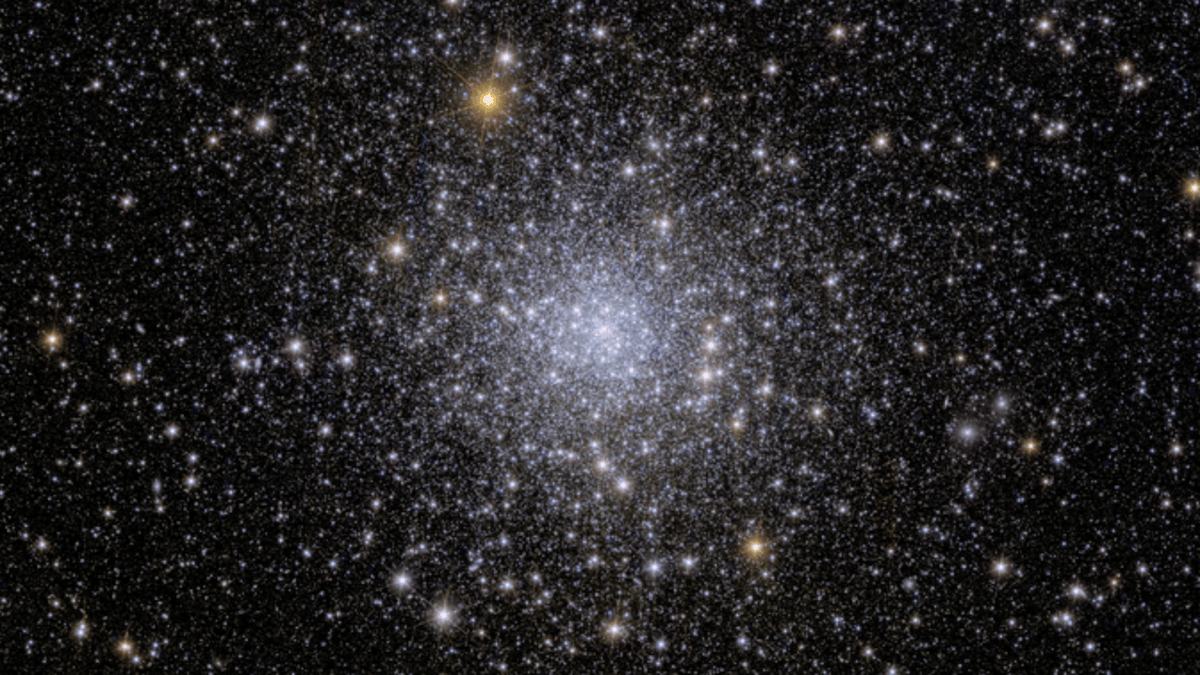
Glittering Star Cluster Image Reveals Missing Patch of Stars: 'We Were Not Looking for the Gap, but We Found It'
Companies Mentioned

Why It Matters
The gap offers a rare empirical test of low‑mass stellar evolution theories and sharpens distance and age measurements for ancient globular clusters, informing Milky Way formation timelines.
Key Takeaways
- •Euclid image shows missing red dwarfs in NGC 6397.
- •Gap linked to transition to fully convective stellar interiors.
- •First globular‑cluster observation of the Gaia‑type HR diagram gap.
- •Helps refine distance and age estimates for ancient clusters.
- •Offers direct test for low‑mass stellar evolution models.
Pulse Analysis
The European Space Agency’s Euclid mission, launched to map dark matter and dark energy, has demonstrated its versatility by delivering an unprecedented portrait of NGC 6397. While the telescope’s primary surveys target the large‑scale structure of the universe, its sharp imaging and precise photometry enable astronomers to dissect dense stellar systems. In this case, researchers combined Euclid data with archival Hubble observations to chart the cluster’s stars by color and brightness, stumbling upon a conspicuous void that would have been invisible without such high‑resolution coverage.
The missing segment corresponds to red dwarf stars undergoing a rapid internal restructuring—from partially convective to fully convective interiors. This transition subtly alters their luminosity, creating a thin under‑populated band on the Hertzsprung‑Russell diagram. A similar gap was first reported in 2018 using Gaia data for millions of nearby stars, but NGC 6397 is the first globular cluster where the phenomenon has been confirmed. Because globular clusters host some of the oldest stars in the Milky Way, they serve as natural laboratories for testing stellar‑evolution theory under extreme density and metallicity conditions. The Euclid finding therefore validates theoretical predictions about low‑mass star convection and offers a concrete data point for refining model parameters.
Beyond pure astrophysics, the gap carries practical benefits for cosmology and galactic archaeology. The precise luminosity at which the void appears can be used as a standard candle, tightening distance estimates to NGC 6397 and, by extension, calibrating the age scale of the Galactic halo. Accurate ages for such ancient clusters feed into models of the Milky Way’s formation and its early merger history. As Euclid continues its survey, astronomers anticipate uncovering comparable gaps in other clusters, potentially establishing a new diagnostic tool for stellar populations across the cosmos.
Glittering star cluster image reveals missing patch of stars: 'We were not looking for the gap, but we found it'
Comments
Want to join the conversation?
Loading comments...