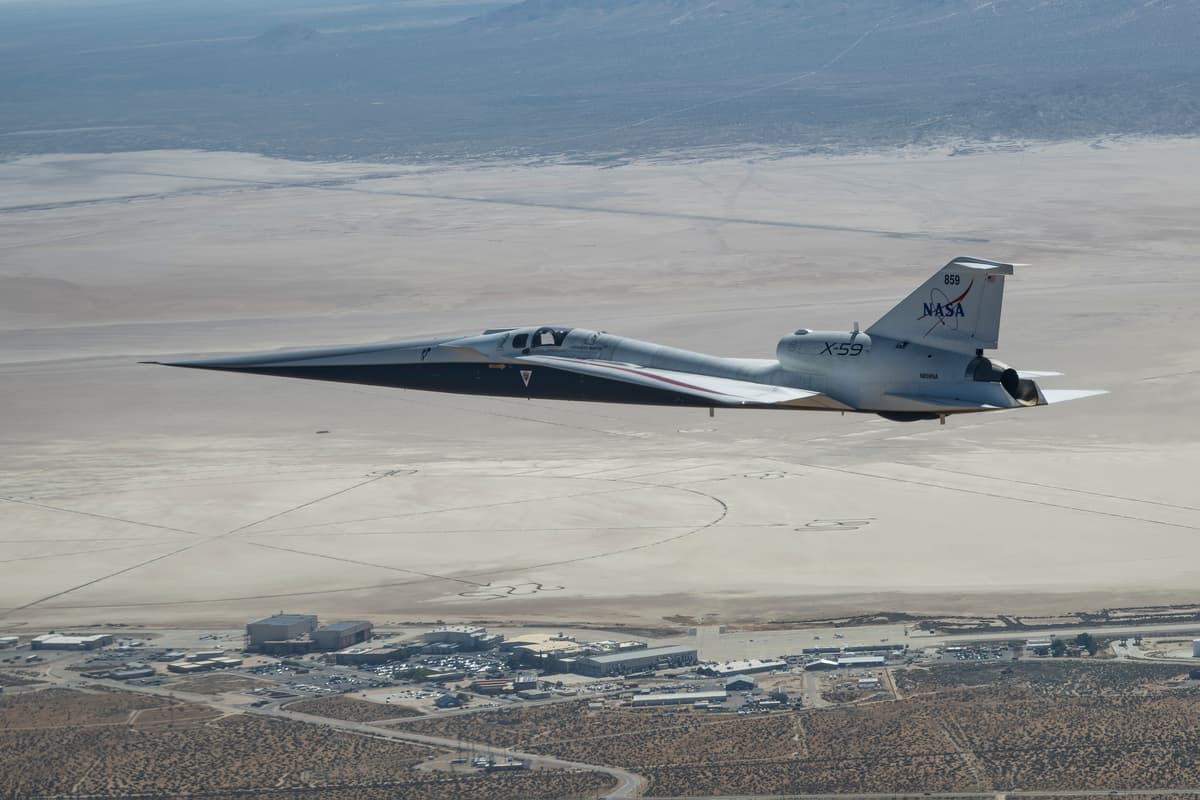
Going Low and Slow in Testing
Why It Matters
Proving low‑speed, low‑altitude performance is critical for certifying the X‑59’s noise‑reduction technology, a prerequisite for commercial supersonic flight and regulatory approval.
Key Takeaways
- •X-59 completed high‑altitude, near‑supersonic test flights.
- •New flights evaluate low‑speed, low‑altitude performance.
- •Tests include gear‑up and gear‑down configurations.
- •Data supports NASA’s Quesst program for quieter supersonic travel.
- •Results move industry closer to commercial quiet supersonic aircraft.
Pulse Analysis
The X‑59, often dubbed the "silent boom" aircraft, incorporates a uniquely shaped nose and advanced engine exhaust design to mitigate the loud sonic booms that have historically barred supersonic travel over land. By reshaping shock waves, NASA hopes to keep perceived noise below 75 phons, a threshold that could satisfy the Federal Aviation Administration’s community‑noise criteria. The Quesst program, launched in 2020, leverages this technology to demonstrate that supersonic jets can coexist with populated areas without disturbing residents.
In the latest flight campaign, engineers shifted focus from the aircraft’s high‑altitude, near‑Mach‑1 regime to a broader flight envelope that includes slower speeds and lower altitudes. These conditions are essential for validating aerodynamic stability, control authority, and the effectiveness of the noise‑cancellation geometry when the landing gear is deployed. Onboard sensors capture pressure distribution, structural loads, and acoustic signatures, feeding a high‑fidelity data set that will refine computational models and inform future design iterations.
If the X‑59 meets its performance and noise targets, the implications for the aerospace industry are profound. Commercial operators could envision routes that cut trans‑Atlantic travel time by half while complying with existing noise regulations, unlocking a new market segment. Moreover, the data will guide regulators in crafting certification standards for next‑generation supersonic aircraft, potentially accelerating investment from firms like Boom Supersonic and Aerion. The success of these tests therefore represents a pivotal step toward reviving supersonic passenger service in a manner that aligns with modern environmental and community expectations.
Going Low and Slow in Testing
Comments
Want to join the conversation?
Loading comments...