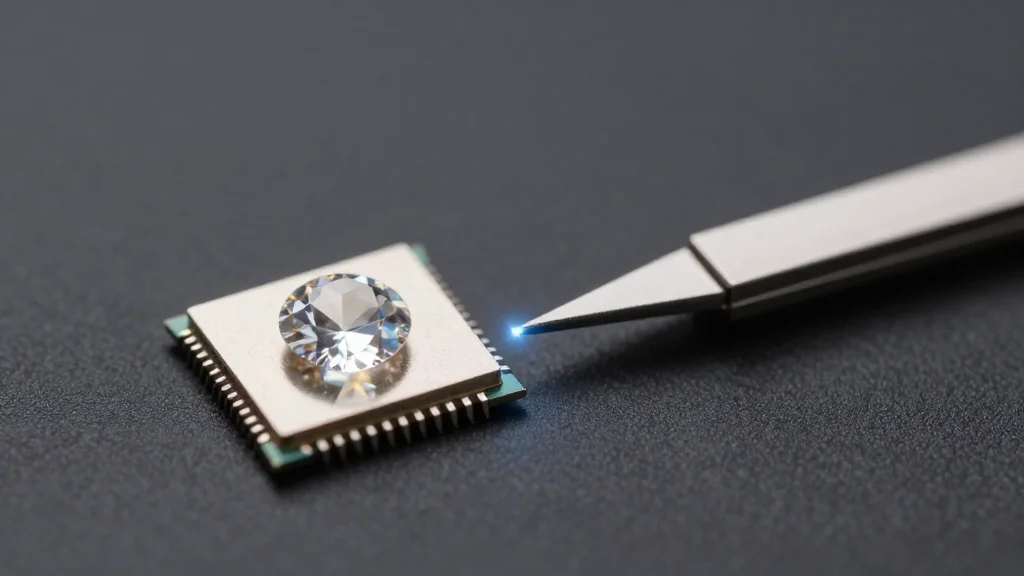
Good Vibrations for Quantum Communications: Engineers Couple Single Phonon to Single Atomic Spin
Why It Matters
By proving that a single vibrational quantum can reliably manipulate a spin qubit, the study opens a pathway to phonon‑based quantum buses that could interconnect diverse quantum processors and sensors, accelerating the development of scalable quantum networks.
Key Takeaways
- •First demonstration of single phonon coupling to a single spin qubit
- •Phonon‑based quantum bus could link disparate quantum processors
- •Diamond colour‑centre platform offers long‑lived, compact quantum memory
- •Strong spin‑phonon interaction enables high‑precision force and temperature sensing
- •Room‑temperature operation moves quantum acoustics closer to practical devices
Pulse Analysis
Quantum communication has traditionally relied on photons, whose wavelengths demand relatively large optical cavities and cryogenic environments. Phonons—quantized mechanical vibrations—offer a contrasting approach: they can be confined in nanoscale resonators and maintain long lifetimes, making them attractive as compact carriers of quantum information. The emerging field of quantum acoustics leverages these properties to envision ‘universal quantum buses’ that bridge otherwise incompatible qubit technologies, from superconducting circuits to solid‑state defects.
The Harvard team, led by Professor Marko Lončar, engineered a diamond chip where a single colour‑centre spin qubit sits adjacent to a nanomechanical resonator. By enhancing the Purcell effect, they amplified the interaction strength so that the absorption or emission of a single phonon flips the spin state. This level of control, achieved at room temperature, demonstrates that phonon‑mediated operations can reach the coherence thresholds required for practical quantum processing. Moreover, the spin serves as an ultra‑sensitive probe of its mechanical environment, opening avenues for quantum‑enhanced sensing of forces, stress, and temperature.
Looking ahead, phononic interconnects could simplify the architecture of quantum computers by reducing the footprint of communication channels and easing integration with existing semiconductor fabrication. The ability to couple disparate qubit platforms through a shared acoustic mode promises hybrid systems that combine the speed of superconducting qubits with the long‑term storage of diamond spins. While challenges remain—such as scaling resonator arrays and mitigating decoherence from material defects—the breakthrough marks a decisive step toward commercial quantum acoustic devices, positioning phonons as a viable backbone for the next generation of quantum networks.
Good vibrations for quantum communications: Engineers couple single phonon to single atomic spin
Comments
Want to join the conversation?
Loading comments...