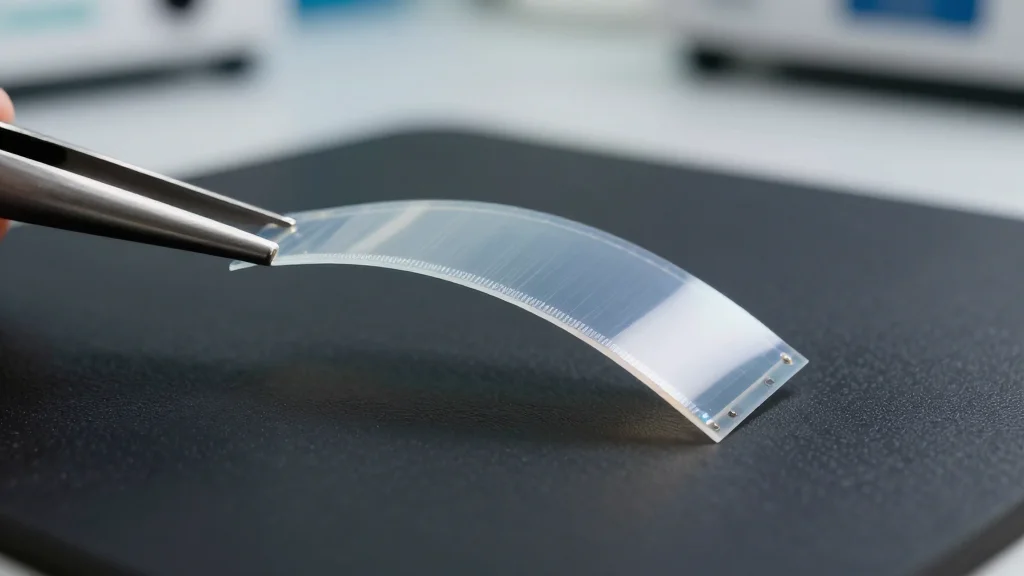
Graphene-Enhanced Flexible GaN LEDs Show 35% Increase in Electroluminescence
Why It Matters
This breakthrough proves that high‑efficiency inorganic LEDs can be made bendable, unlocking new applications in wearable electronics and flexible photonic integration where durability and brightness are critical.
Key Takeaways
- •Graphene TCS layer raises flexible GaN LED brightness 35% at 50 mA.
- •Blue‑shifted photoluminescence indicates higher output power than reference.
- •Uniform current spreading reduces crowding, enhancing radiative recombination.
- •Piezophototronic effect enables mechanical tuning of emission wavelength.
- •Laser lift‑off process yields wafer‑scale, bendable GaN films for wearables.
Pulse Analysis
Flexible light‑emitting diodes have long been limited by the rigidity of traditional semiconductor substrates, which hampers integration into wearable and conformal devices. By transferring thin GaN films onto a carbon‑reinforced PET sheet and employing a laser‑lift‑off technique, the Korean research teams have overcome this barrier, delivering a truly bendable inorganic LED platform. The addition of a CVD graphene layer as a transparent current‑spreading electrode not only preserves optical clarity but also leverages graphene’s exceptional electrical conductivity to distribute current evenly across the device surface.
The graphene‑enhanced LEDs exhibit a 35% boost in electroluminescence intensity at a modest 50 mA drive current, a gain corroborated by photoluminescence measurements that reveal a pronounced blue shift and higher peak intensity. These optical improvements arise from reduced current crowding and more uniform carrier injection into the InGaN/GaN quantum wells, which translates into greater radiative recombination efficiency. Moreover, the study explores the piezophototronic effect—mechanical strain generating polarization charges that modulate band structures—demonstrating that bending the device can fine‑tune emission characteristics, a feature valuable for adaptive lighting and sensing applications.
The convergence of wafer‑scale laser lift‑off processing, graphene’s two‑dimensional conductivity, and strain‑engineered band modulation positions this technology as a cornerstone for next‑generation flexible optoelectronics. Industries ranging from wearable displays and smart textiles to integrated photonic circuits stand to benefit from LEDs that combine mechanical resilience with high luminous output. Future work will likely focus on scaling the manufacturing flow, optimizing graphene transfer methods, and integrating driver electronics to bring these high‑performance flexible LEDs to commercial markets.
Graphene-enhanced flexible GaN LEDs show 35% increase in electroluminescence
Comments
Want to join the conversation?
Loading comments...