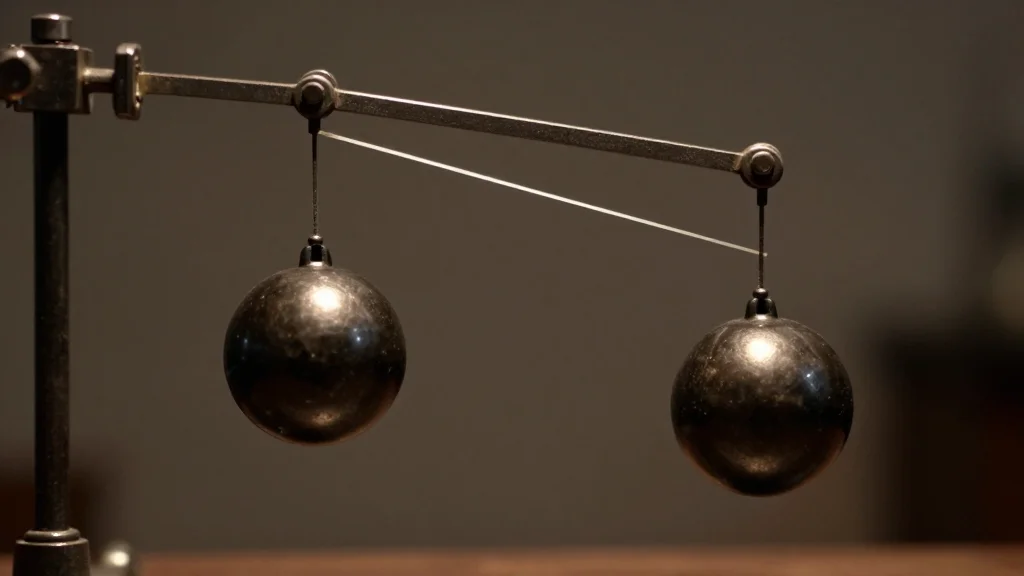
Gravitational Constant’s Value Still Up in the Air
Why It Matters
Accurate knowledge of G is essential for precision metrology, fundamental physics calculations, and the integrity of international measurement standards.
Key Takeaways
- •NIST reports G = 6.67387×10⁻¹¹ m³ kg⁻¹ s⁻², 57 ppm uncertainty.
- •Result is 250 ppm lower than 2014 BIPM value, matches world average.
- •Four‑mass torsion balance cuts background noise but needs sub‑micron alignment.
- •Researchers attribute scatter to multiple subtle systematic effects, not a single cause.
Pulse Analysis
The gravitational constant, denoted G, remains one of the most stubborn parameters in physics. Since Henry Cavendish’s 1798 torsion‑balance experiment, scientists have chased ever‑tighter uncertainties, yet the spread among modern determinations still reaches several hundred parts per million. This discrepancy matters because G underpins calculations ranging from satellite orbits to the mass of the Earth, and any error propagates through a host of engineering and scientific models.
NIST’s latest effort revisited the 2014 BIPM torsion‑balance design, adding two extra test masses to suppress external gravitational perturbations. By conducting parallel force measurements—mechanical torque and electrostatic balance—the team achieved a 57 ppm uncertainty, a notable improvement in precision. Their value, 6.67387×10⁻¹¹ m³ kg⁻¹ s⁻², sits comfortably within the CODATA average but diverges by 250 ppm from the earlier BIPM result, highlighting that even sophisticated setups cannot fully eliminate hidden biases.
The persistence of scatter suggests that multiple, inter‑related systematic effects—thermal gradients, material inhomogeneities, minute positioning errors—collectively obscure the true constant. Researchers are now turning to alternative techniques such as atom interferometry, which promise fundamentally different error sources. Resolving G’s uncertainty will sharpen the foundation of metrology, improve the fidelity of gravitational models, and reinforce confidence in the standards that underpin global trade, navigation, and scientific discovery.
Gravitational Constant’s Value Still Up in the Air
Comments
Want to join the conversation?
Loading comments...