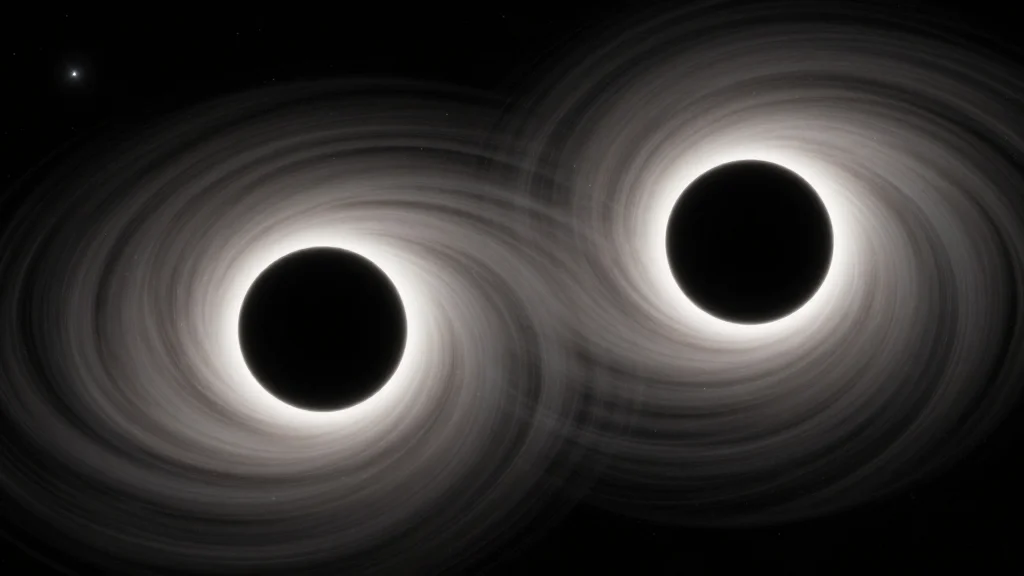
Gravitational Waves From Colliding Black Holes May Allow Detection of Dark Matter
Why It Matters
If validated, this technique could turn black‑hole mergers into astrophysical laboratories for detecting dark matter, expanding the toolkit beyond traditional particle experiments.
Key Takeaways
- •MIT team created waveform model for black‑hole mergers in dark‑matter clouds.
- •Analysis of 28 LVK events found one candidate, GW190728, with dark‑matter imprint.
- •Method enables systematic search for dark matter using future gravitational‑wave detections.
- •Superradiance can amplify light‑scalar dark matter around spinning black holes.
- •Study published in Physical Review Letters; data are publicly accessible.
Pulse Analysis
Gravitational‑wave astronomy has rapidly matured since the first LIGO detection, offering a direct probe of extreme gravity. Yet the elusive nature of dark matter—detectable only through its gravitational influence—has left scientists searching for indirect signatures. By integrating theoretical predictions of how light‑scalar dark matter interacts with spinning black holes, researchers can now examine subtle deviations in waveforms, turning each merger into a potential dark‑matter detector. This approach complements traditional searches that rely on underground detectors or collider experiments, broadening the observational landscape.
The MIT‑led team leveraged superradiance—a process where a rotating black hole transfers energy to surrounding scalar fields—to model dense dark‑matter environments. Their simulations generate distinct waveform features, such as phase shifts and amplitude modulations, that differ from vacuum mergers. When applied to the LVK catalog, 27 events matched vacuum expectations, while GW190728 displayed a modest preference for the dark‑matter model. Although the signal lacks the statistical weight for a claim, it validates the methodology and highlights the importance of refined waveform libraries for future analyses.
Looking ahead, upgraded detectors and longer observing runs will increase the volume and fidelity of merger data, enhancing the sensitivity to faint dark‑matter imprints. Collaborative efforts between astrophysicists, particle theorists, and data scientists will be crucial to refine models, quantify uncertainties, and cross‑validate findings with complementary probes such as galaxy‑lensing surveys. If successful, this strategy could pinpoint dark‑matter properties at sub‑astronomical scales, marking a paradigm shift in the quest to uncover the universe’s missing mass.
Gravitational waves from colliding black holes may allow detection of dark matter
Comments
Want to join the conversation?
Loading comments...