Gravity's Strength Measured More Reliably than Ever Before
Why It Matters
A tighter big G value sharpens fundamental‑physics calculations and improves the accuracy of geophysical and astronomical models, influencing everything from satellite navigation to tests of alternative gravity theories.
Key Takeaways
- •NIST team achieved 0.01% uncertainty in G measurement.
- •New torsion balance design reduces thermal and seismic noise.
- •Results align within 2σ of previous leading experiments.
- •Improved G value refines planetary mass calculations.
- •Precision may test alternative gravity theories.
Pulse Analysis
Measuring the gravitational constant, big G, has been a persistent challenge for over two centuries because gravity is the weakest of the four fundamental forces. Traditional methods—ranging from pendulum experiments to atom interferometry—have produced values that differ by more than their quoted uncertainties, leaving a puzzling discrepancy in the physics community. This lack of agreement hampers precise calculations in fields such as planetary science, where G directly influences mass estimates of celestial bodies, and in high‑precision tests of general relativity.
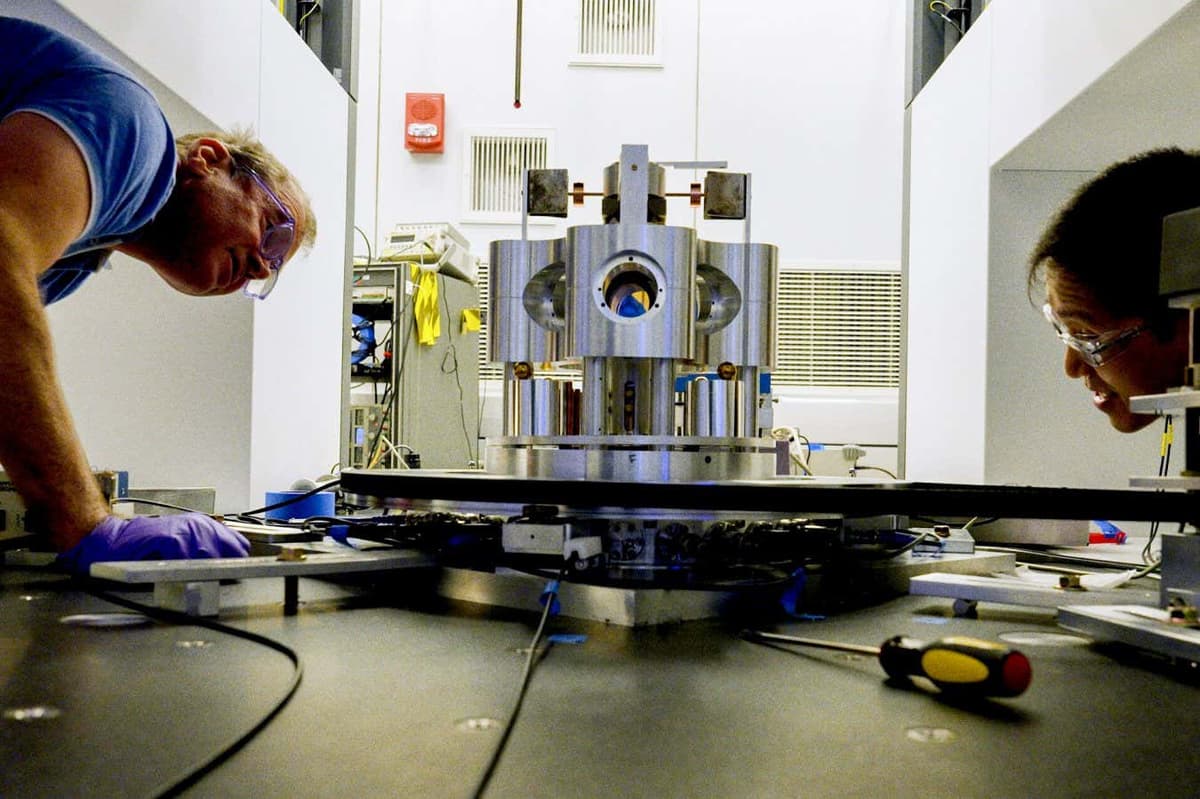
The breakthrough comes from a NIST team led by Stephan Schlamminger, who refined the classic torsion‑balance technique with modern engineering. The apparatus employs ultra‑low‑expansion materials, active vibration isolation, and a cryogenic environment that suppresses thermal drift. By calibrating the system against laser interferometry and conducting thousands of measurement cycles, the researchers reduced random and systematic errors to unprecedented levels, achieving a relative uncertainty of just 0.01%. This result not only falls within the statistical envelope of the most accurate prior determinations but also narrows the spread that has plagued the field for decades.
A more reliable G value carries significant implications. It enhances the fidelity of orbital mechanics models used by aerospace firms and improves the calibration of instruments that rely on precise force measurements. Moreover, the heightened precision opens a new window for probing physics beyond the Standard Model, allowing scientists to test speculative theories that predict subtle deviations in gravitational strength at short ranges. As the community works toward a universally accepted constant, NIST’s achievement marks a pivotal step toward unifying experimental data and deepening our understanding of the universe’s most enigmatic force.
Gravity's strength measured more reliably than ever before
Comments
Want to join the conversation?
Loading comments...